math1044\ntask:\nanalyze the relative and absolute extrema for the function below by completing the steps…
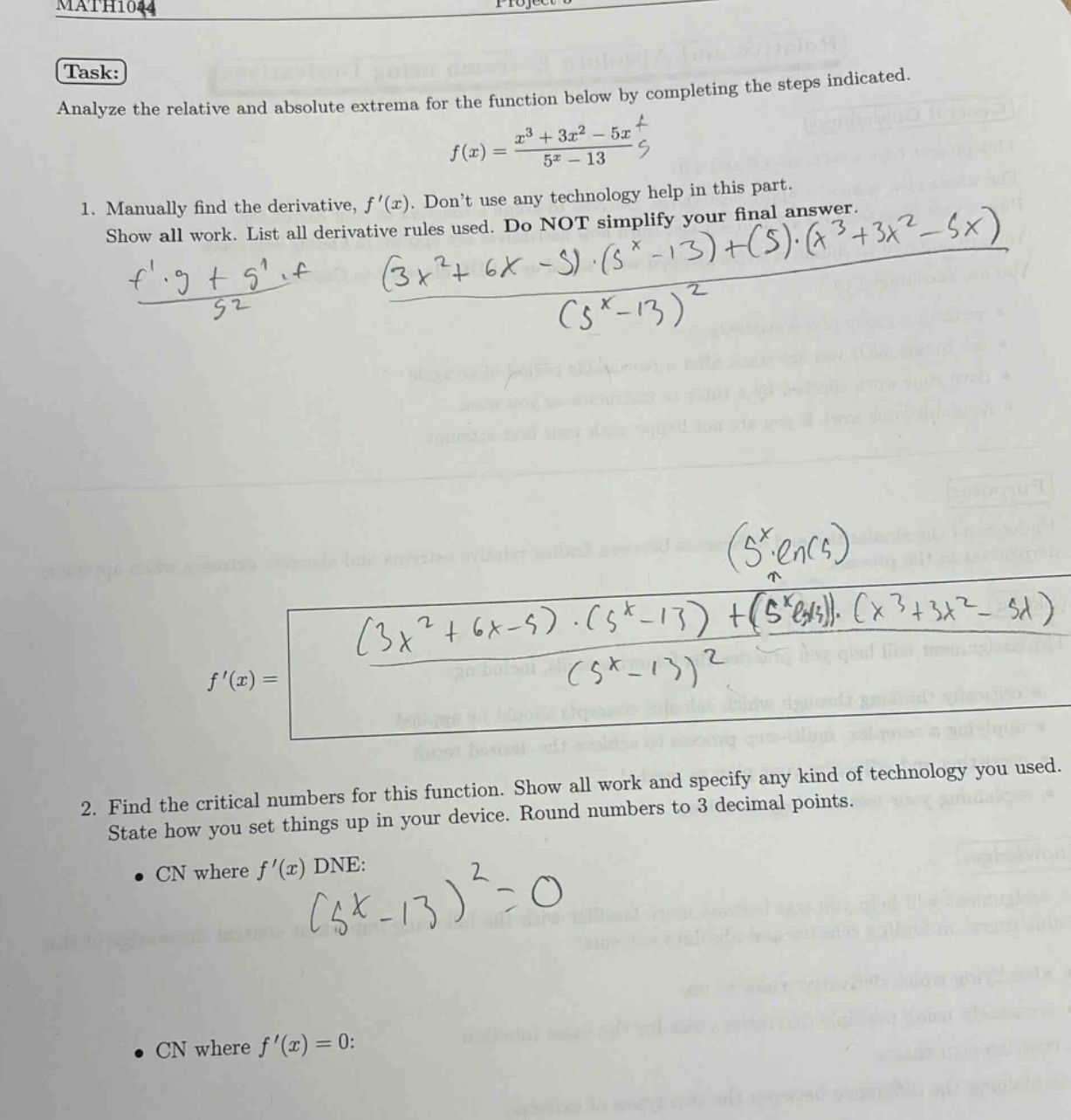
math1044\ntask:\nanalyze the relative and absolute extrema for the function below by completing the steps indicated.\n f(x)=\frac{x^{3}+3 x^{2}-5 x}{5^{x}-13} \n1. manually find the derivative, ( f(x) ). dont use any technology help in this part.\nshow all work. list all derivative rules used. do not simplify your final answer.\n \frac{fcdot g + gcdot f}{g^{2}}quad\frac{(3x^{2}+6x - 5)cdot(5^{x}-13)+(5^{x}cdotln(5))cdot(x^{3}+3x^{2}-5x)}{(5^{x}-13)^{2}} \n f(x)=\frac{(3x^{2}+6x - 5)cdot(5^{x}-13)+(5^{x}cdotln(5))cdot(x^{3}+3x^{2}-5x)}{(5^{x}-13)^{2}} \n2. find the critical numbers for this function. show all work and specify any kind of technology you used.\nstate how you set things up in your device. round numbers to 3 decimal points.\n- cn where ( f(x) ) dne:\n (5^{x}-13)^{2}=0 \n- cn where ( f(x)=0:
Answer
Explanation:
Step1: Identify derivative rules
Use quotient - rule $\left(\frac{u}{v}\right)'=\frac{u'v - uv'}{v^{2}}$, where $u = x^{3}+3x^{2}-5x$, $u'=3x^{2}+6x - 5$ and $v = 5^{x}-13$, $v'=5^{x}\ln(5)$.
Step2: Apply quotient - rule
$f'(x)=\frac{(3x^{2}+6x - 5)(5^{x}-13)-(x^{3}+3x^{2}-5x)(5^{x}\ln(5))}{(5^{x}-13)^{2}}$
Step3: Find where $f'(x)$ DNE
Set the denominator of $f'(x)$ equal to 0. $(5^{x}-13)^{2}=0$ implies $5^{x}-13 = 0$. Solving for $x$, we get $5^{x}=13$, so $x=\log_{5}(13)=\frac{\ln(13)}{\ln(5)}\approx1.594$.
Step4: Find where $f'(x)=0$
Set the numerator of $f'(x)$ equal to 0: $(3x^{2}+6x - 5)(5^{x}-13)-(x^{3}+3x^{2}-5x)(5^{x}\ln(5)) = 0$. This is a non - linear equation. One way to solve it is to use a graphing utility (e.g., a graphing calculator like TI - 84 Plus). Graph the function $y=(3x^{2}+6x - 5)(5^{x}-13)-(x^{3}+3x^{2}-5x)(5^{x}\ln(5))$ and find the $x$ - intercepts. Another way is to use numerical methods like Newton - Raphson method. Let $g(x)=(3x^{2}+6x - 5)(5^{x}-13)-(x^{3}+3x^{2}-5x)(5^{x}\ln(5))$. Then $g'(x)$ needs to be calculated (using product and chain rules) and the iterative formula $x_{n + 1}=x_{n}-\frac{g(x_{n})}{g'(x_{n})}$ is applied. Using a graphing calculator, we find the roots (critical numbers where $f'(x) = 0$) after setting up the function in the $Y=$ editor and using the zero - finding feature.
Answer:
Critical numbers where $f'(x)$ DNE: $x\approx1.594$. Critical numbers where $f'(x)=0$ are found using a graphing utility or numerical methods.