which mathematical situation can be graphed using a step - function?\no each output is the place value of…
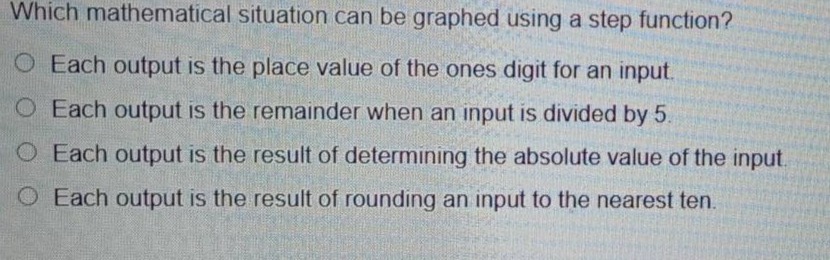
which mathematical situation can be graphed using a step - function?\no each output is the place value of the ones digit for an input.\no each output is the remainder when an input is divided by 5.\no each output is the result of determining the absolute value of the input.\no each output is the result of rounding an input to the nearest ten.
Answer
Answer:
Each output is the remainder when an input is divided by 5.
Explanation:
Step1: Understand step - function
A step - function has distinct "steps" in its graph.
Step2: Analyze first option
The place - value of the ones digit is not a step - function as it doesn't have a step - like pattern.
Step3: Analyze second option
When an input (x) is divided by 5, the remainder (r) satisfies (0\leq r<5). As (x) changes, the remainder has distinct intervals and jumps, forming a step - function.
Step4: Analyze third option
The absolute - value function (y = |x|) is a V - shaped graph, not a step - function.
Step5: Analyze fourth option
Rounding to the nearest ten is not a step - function in the strict sense as the transition is not in a simple step - like pattern for all values.