2. (mcquarrie, §20.3) find all twice - continuously differentiable functions y = y(x) that satisfy the…
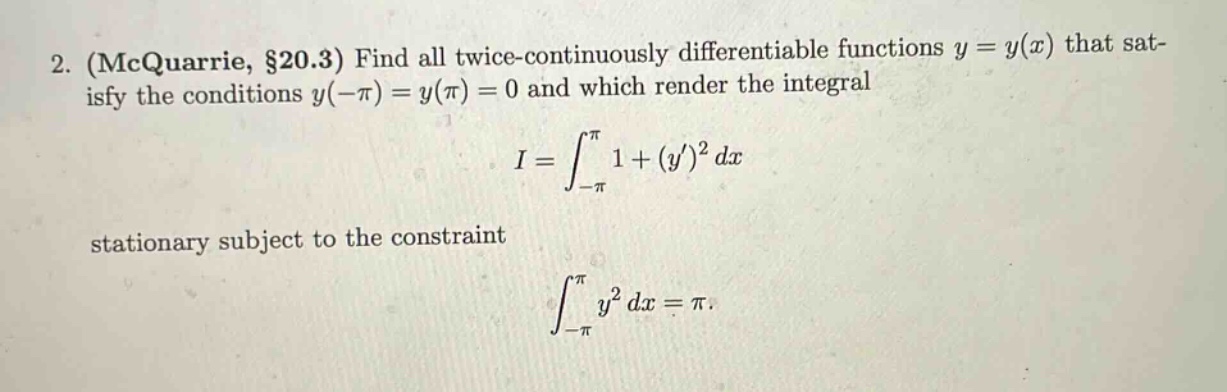
2. (mcquarrie, §20.3) find all twice - continuously differentiable functions y = y(x) that satisfy the conditions y(-π) = y(π) = 0 and which render the integral i = ∫-π,π 1+(y)² dx stationary subject to the constraint ∫-π,π y² dx = π.
Answer
Explanation:
Step1: Set up the functional
We use the method of Lagrange - multipliers for functionals. Let (F(x,y,y')=1+(y')^{2}+\lambda y^{2}), where (\lambda) is the Lagrange - multiplier. The Euler - Lagrange equation is given by (\frac{\partial F}{\partial y}-\frac{d}{dx}\left(\frac{\partial F}{\partial y'}\right)=0).
Step2: Calculate the partial derivatives
First, (\frac{\partial F}{\partial y} = 2\lambda y) and (\frac{\partial F}{\partial y'}=2y'). Then (\frac{d}{dx}\left(\frac{\partial F}{\partial y'}\right)=2y'').
Step3: Obtain the differential equation
Substituting into the Euler - Lagrange equation, we get (2\lambda y-2y'' = 0), which simplifies to (y''-\lambda y = 0).
Step4: Solve the differential equation
The general solution of (y''-\lambda y = 0) depends on the sign of (\lambda).
- Case 1: If (\lambda = 0), then (y(x)=Ax + B). Using the boundary conditions (y(-\pi)=y(\pi)=0), we have (-A\pi + B=A\pi + B = 0), which gives (A = 0) and (B = 0). But this does not satisfy (\int_{-\pi}^{\pi}y^{2}dx=\pi).
- Case 2: If (\lambda>0), let (\lambda = k^{2}), (k>0). The general solution is (y(x)=A\cos(kx)+B\sin(kx)). Using (y(-\pi)=y(\pi)=0), we have (A\cos(-k\pi)+B\sin(-k\pi)=A\cos(k\pi)+B\sin(k\pi)=0). Since (\cos(-k\pi)=\cos(k\pi)) and (\sin(-k\pi)=-\sin(k\pi)), we get (A\cos(k\pi)+B\sin(k\pi)=A\cos(k\pi)-B\sin(k\pi)=0), so (B = 0) and (\cos(k\pi)=0), then (k = n+\frac{1}{2},n\in\mathbb{Z}).
- Case 3: If (\lambda<0), let (\lambda=-k^{2}), (k>0). The general solution is (y(x)=A\cosh(kx)+B\sinh(kx)). Using (y(-\pi)=y(\pi)=0), we have (A\cosh(-k\pi)+B\sinh(-k\pi)=A\cosh(k\pi)+B\sinh(k\pi)=0). Since (\cosh(-k\pi)=\cosh(k\pi)) and (\sinh(-k\pi)=-\sinh(k\pi)), we get (A\cosh(k\pi)-B\sinh(k\pi)=A\cosh(k\pi)+B\sinh(k\pi)=0), which gives (A = B = 0) (not valid as it does not satisfy (\int_{-\pi}^{\pi}y^{2}dx=\pi)). Now, with (y(x)=A\cos((n + \frac{1}{2})x)), we calculate (\int_{-\pi}^{\pi}y^{2}dx=\int_{-\pi}^{\pi}A^{2}\cos^{2}((n+\frac{1}{2})x)dx). Using the identity (\cos^{2}\alpha=\frac{1 + \cos(2\alpha)}{2}), we have (\int_{-\pi}^{\pi}A^{2}\cos^{2}((n+\frac{1}{2})x)dx=A^{2}\int_{-\pi}^{\pi}\frac{1+\cos((2n + 1)x)}{2}dx). Since (\int_{-\pi}^{\pi}\cos((2n + 1)x)dx = 0), then (\int_{-\pi}^{\pi}A^{2}\cos^{2}((n+\frac{1}{2})x)dx=A^{2}\pi). Given (\int_{-\pi}^{\pi}y^{2}dx=\pi), we get (A=\pm1).
Answer:
(y(x)=\pm\cos((n+\frac{1}{2})x),n = 0,1,2,\cdots)