the mean value theorem guarantees the existence of a special point on the graph of $y = sqrt{x}$ between…
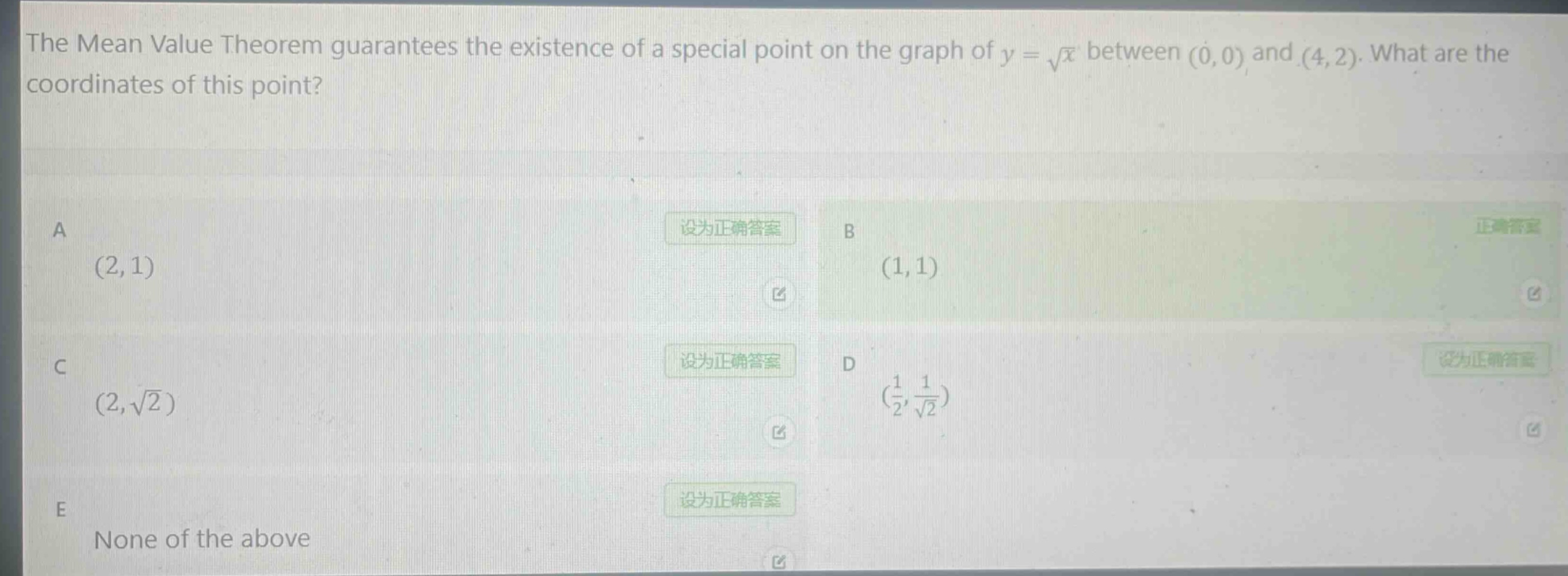
the mean value theorem guarantees the existence of a special point on the graph of $y = sqrt{x}$ between $(0,0)$ and $(4,2)$. what are the coordinates of this point?\na $(2,1)$\nb $(1,1)$\nc $(2,sqrt{2})$\nd $(\frac{1}{2},\frac{1}{sqrt{2}})$\ne none of the above
Answer
Explanation:
Step1: Recall Mean - Value Theorem formula
The Mean - Value Theorem states that if (y = f(x)) is continuous on the closed interval ([a,b]) and differentiable on the open interval ((a,b)), then (f'(c)=\frac{f(b)-f(a)}{b - a}), where (a = 0), (b = 4), and (f(x)=\sqrt{x}=x^{\frac{1}{2}}). First, find (\frac{f(b)-f(a)}{b - a}). [ \begin{align*} \frac{f(4)-f(0)}{4 - 0}&=\frac{\sqrt{4}-\sqrt{0}}{4}\ &=\frac{2 - 0}{4}\ &=\frac{1}{2} \end{align*} ]
Step2: Find the derivative of (y = f(x))
Differentiate (y = f(x)=\sqrt{x}=x^{\frac{1}{2}}) using the power - rule ((x^n)'=nx^{n - 1}). So (f'(x)=\frac{1}{2\sqrt{x}}).
Step3: Solve for (x) (i.e., (c))
Set (f'(c)=\frac{1}{2}), then (\frac{1}{2\sqrt{c}}=\frac{1}{2}). Cross - multiply to get (2 = 2\sqrt{c}), which simplifies to (\sqrt{c}=1), and then (c = 1).
Step4: Find the (y) - coordinate
Substitute (x = 1) into (y=\sqrt{x}), so (y=\sqrt{1}=1).
Answer:
B. ((1,1))