5. a medication is administered to a patient. the amount, in milligrams, of the medication in the patient at…
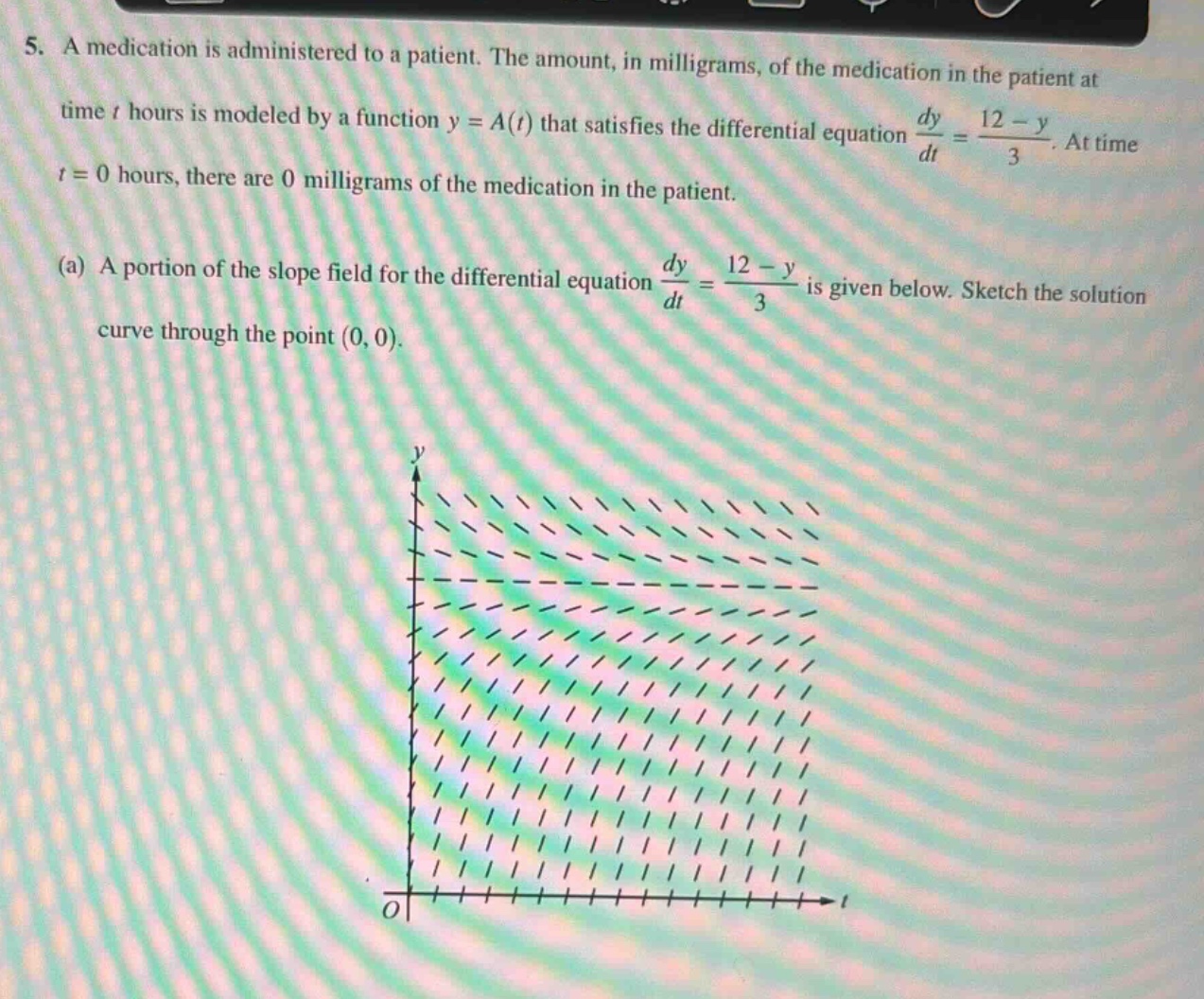
5. a medication is administered to a patient. the amount, in milligrams, of the medication in the patient at time t hours is modeled by a function y = a(t) that satisfies the differential equation dy/dt=(12 - y)/3. at time t = 0 hours, there are 0 milligrams of the medication in the patient. (a) a portion of the slope field for the differential equation dy/dt=(12 - y)/3 is given below. sketch the solution curve through the point (0, 0).
Answer
Explanation:
Step1: Analyze slope at (0,0)
When (t = 0,y=0), (\frac{dy}{dt}=\frac{12 - 0}{3}=4). So at the point ((0,0)) the slope of the solution - curve is 4.
Step2: Analyze equilibrium points
Set (\frac{dy}{dt}=0), then (\frac{12 - y}{3}=0), which gives (y = 12). This is an equilibrium point. When (y<12), (\frac{dy}{dt}>0) and the function is increasing. When (y>12), (\frac{dy}{dt}<0) and the function is decreasing.
Step3: Sketch the curve
Start at the point ((0,0)) with a positive - slope of 4. As (t) increases, the curve will increase and approach the horizontal asymptote (y = 12) since the function is increasing for (y<12) and the slope approaches 0 as (y) approaches 12.
Answer:
Sketch a curve starting at the point ((0,0)) with a positive slope. The curve should increase and approach the horizontal line (y = 12) as (t) increases.