a microphone detects sound based on the distance and direction of the sound from the microphone. the…
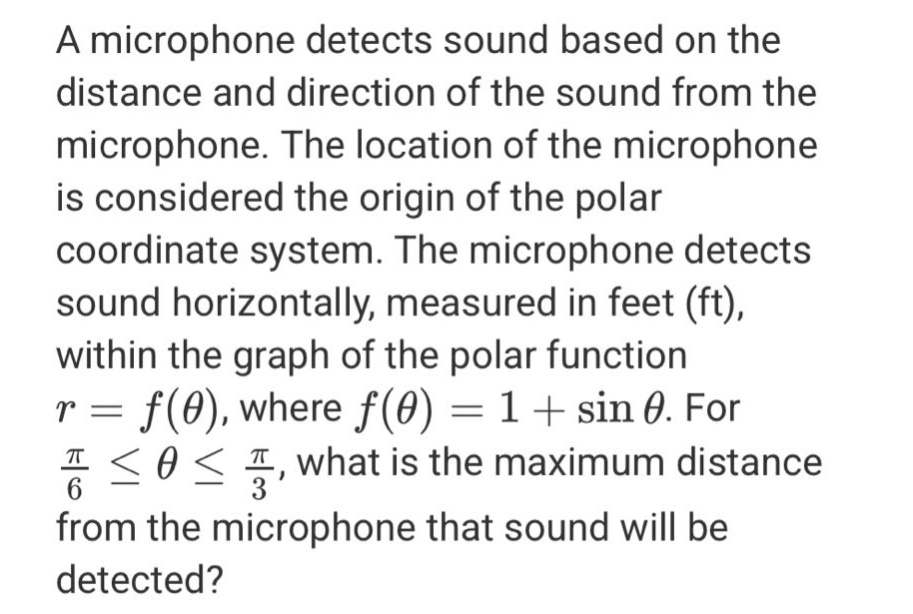
a microphone detects sound based on the distance and direction of the sound from the microphone. the location of the microphone is considered the origin of the polar coordinate system. the microphone detects sound horizontally, measured in feet (ft), within the graph of the polar function r = f(θ), where f(θ)=1 + sin θ. for π/6 ≤ θ ≤ π/3, what is the maximum distance from the microphone that sound will be detected?
Answer
Explanation:
Step1: Analyze the sine - function
The function is $r = 1+\sin\theta$, and we know that the sine function $y = \sin\theta$ is increasing on the interval $\left[\frac{\pi}{6},\frac{\pi}{3}\right]$. The formula for the sine function is $y=\sin\theta$.
Step2: Find the maximum value of $\sin\theta$ in the given interval
The maximum value of $\sin\theta$ in the interval $\left[\frac{\pi}{6},\frac{\pi}{3}\right]$ occurs when $\theta=\frac{\pi}{3}$. Since $\sin\frac{\pi}{3}=\frac{\sqrt{3}}{2}$.
Step3: Calculate the maximum value of $r$
Substitute $\sin\theta=\frac{\sqrt{3}}{2}$ into $r = 1+\sin\theta$. $r=1 + \frac{\sqrt{3}}{2}=\frac{2 + \sqrt{3}}{2}\approx1.866$.
Answer:
$\frac{2+\sqrt{3}}{2}$