what is the minimal degree taylor polynomial centered at a = 0 that you need to calculate sin(1) to 3…
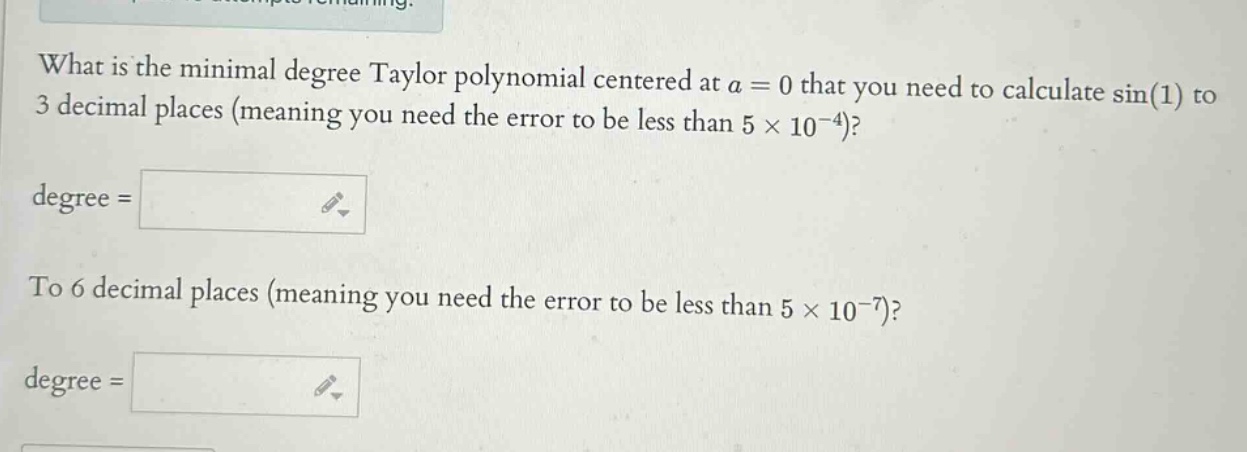
what is the minimal degree taylor polynomial centered at a = 0 that you need to calculate sin(1) to 3 decimal places (meaning you need the error to be less than 5 × 10^(-4))? degree = to 6 decimal places (meaning you need the error to be less than 5 × 10^(-7))? degree =
Answer
Explanation:
Step1: Recall the Lagrange - form of the remainder
The Lagrange - form of the remainder for the Taylor polynomial $P_n(x)$ of a function $f(x)$ centered at $a$ is given by $R_n(x)=\frac{f^{(n + 1)}(c)}{(n+1)!}(x - a)^{n + 1}$, where $c$ is some number between $a$ and $x$. For $f(x)=\sin(x)$ centered at $a = 0$, $f^{(k)}(x)=\sin(x+\frac{k\pi}{2})$, and $|f^{(k)}(x)|\leq1$ for all $x$ and $k$. Here $x = 1$ and $a = 0$, so $|R_n(1)|\leq\frac{|1|^{n + 1}}{(n+1)!}=\frac{1}{(n+1)!}$.
Step2: Find $n$ for 3 - decimal - place accuracy
We want $|R_n(1)|<5\times10^{-4}$. We check values of $n$: For $n = 3$, $\frac{1}{(3 + 1)!}=\frac{1}{4!}=\frac{1}{24}\approx0.0417>5\times10^{-4}$. For $n = 4$, $\frac{1}{(4+1)!}=\frac{1}{5!}=\frac{1}{120}\approx0.0083>5\times10^{-4}$. For $n = 5$, $\frac{1}{(5 + 1)!}=\frac{1}{6!}=\frac{1}{720}\approx0.0014>5\times10^{-4}$. For $n = 6$, $\frac{1}{(6+1)!}=\frac{1}{7!}=\frac{1}{5040}\approx0.000198<5\times10^{-4}$.
Step3: Find $n$ for 6 - decimal - place accuracy
We want $|R_n(1)|<5\times10^{-7}$. We check values of $n$: For $n = 8$, $\frac{1}{(8+1)!}=\frac{1}{9!}=\frac{1}{362880}\approx2.76\times10^{-6}>5\times10^{-7}$. For $n = 9$, $\frac{1}{(9 + 1)!}=\frac{1}{10!}=\frac{1}{3628800}\approx2.76\times10^{-7}<5\times10^{-7}$.
Answer:
degree = 6 degree = 9