move the graphs of f(x) and g(x) into the table.\nfunction f(x)=2e^x g(x)=2^x\ngraph
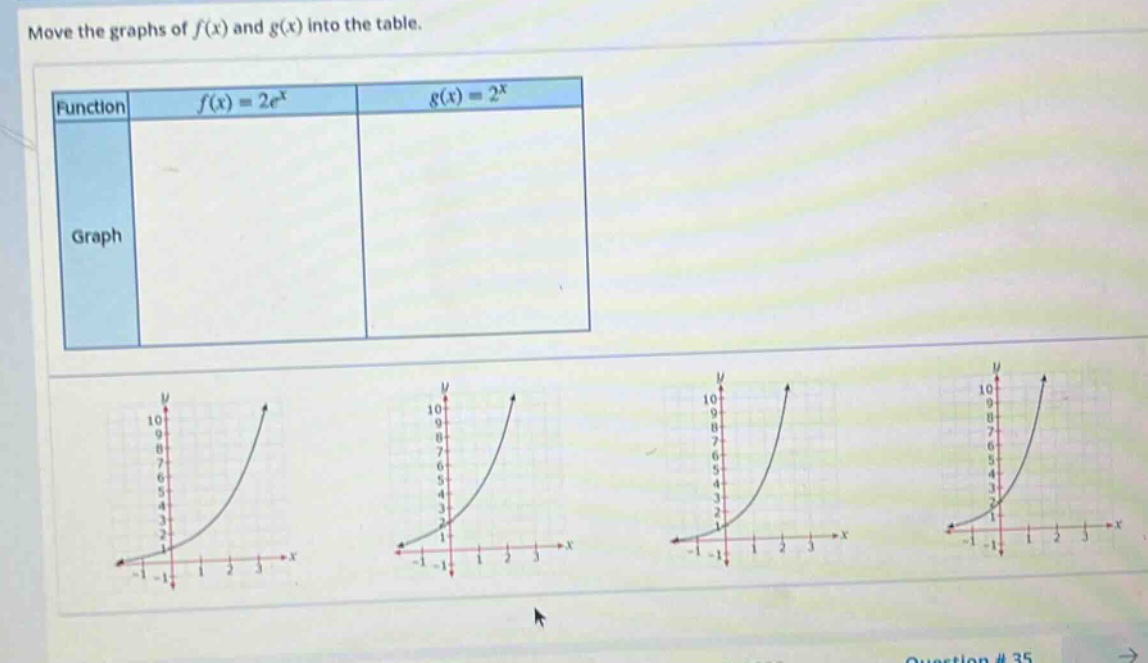
move the graphs of f(x) and g(x) into the table.\nfunction f(x)=2e^x g(x)=2^x\ngraph
Answer
Explanation:
We need to identify the graphs corresponding to the functions $f(x) = 2e^x$ and $g(x) = 2^x$. We can do this by evaluating the functions at specific points, typically $x=0$ and $x=1$.
Step1: Evaluate $f(x) = 2e^x$ at $x=0$ and $x=1$.
For $x=0$: $f(0) = 2e^0 = 2 \cdot 1 = 2$ The point $(0, 2)$ is on the graph of $f(x)$. For $x=1$: $f(1) = 2e^1 = 2e \approx 2 \cdot 2.718 = 5.436$ The point $(1, 2e \approx 5.436)$ is on the graph of $f(x)$.
Step2: Evaluate $g(x) = 2^x$ at $x=0$ and $x=1$.
For $x=0$: $g(0) = 2^0 = 1$ The point $(0, 1)$ is on the graph of $g(x)$. For $x=1$: $g(1) = 2^1 = 2$ The point $(1, 2)$ is on the graph of $g(x)$.
Step3: Identify the graph for $f(x) = 2e^x$.
We look for a graph that passes through $(0, 2)$ and approximately $(1, 5.4)$. The first graph from the left (Graph 1) passes through $(0,2)$ and at $x=1$, the y-value is between 5 and 6, consistent with $2e \approx 5.436$.
Step4: Identify the graph for $g(x) = 2^x$.
We look for a graph that passes through $(0, 1)$ and $(1, 2)$. The second graph from the left (Graph 2) passes through $(0,1)$ and $(1,2)$.
Answer:
The table should be filled as follows:
| Function | Graph |
|---|---|
| $f(x) = 2e^x$ | The first graph from the left, which passes through $(0,2)$ and $(1, \approx 5.4)$. |
| $g(x) = 2^x$ | The second graph from the left, which passes through $(0,1)$ and $(1,2)$. |