the movement of the progress bar may be uneven because questions can be worth more or less (including zero)…
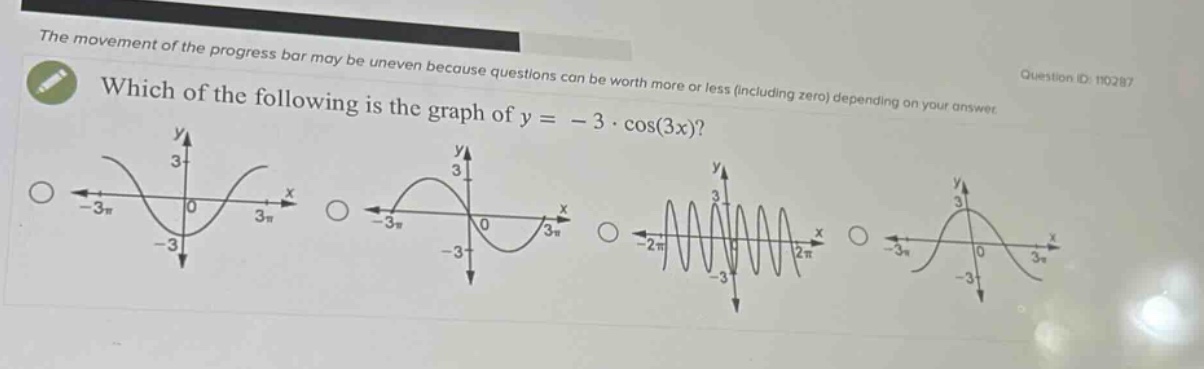
the movement of the progress bar may be uneven because questions can be worth more or less (including zero) depending on your answer. question id: 110287 which of the following is the graph of y = - 3 · cos(3x)?
Answer
Explanation:
Step1: Recall cosine - function properties
The general form of a cosine function is $y = A\cos(Bx - C)+D$. For the function $y=-3\cos(3x)$, we have $A = - 3$, $B = 3$, $C = 0$, and $D = 0$.
Step2: Determine the amplitude
The amplitude of the function $y = A\cos(Bx)$ is given by $|A|$. Here, $|A|=| - 3|=3$, so the graph oscillates between $y = 3$ and $y=-3$.
Step3: Determine the period
The period of the function $y=\cos(Bx)$ is $T=\frac{2\pi}{|B|}$. For $y=-3\cos(3x)$, $B = 3$, so the period $T=\frac{2\pi}{3}$.
Step4: Analyze the negative sign
The negative sign in front of the cosine function reflects the graph of $y = 3\cos(3x)$ about the $x -$axis. When $x = 0$, $y=-3\cos(0)=-3$.
Answer:
The graph that has an amplitude of 3 (oscillates between $y = 3$ and $y=-3$), a period of $\frac{2\pi}{3}$, and starts at the point $(0, - 3)$ (since when $x = 0$, $y=-3$) is the correct graph. Without seeing the specific options clearly labeled, based on these properties, you should be able to identify the correct graph among the choices.