5 multiple choice 1 point the figure above shows the graph of f, the derivative of the function f, on the…
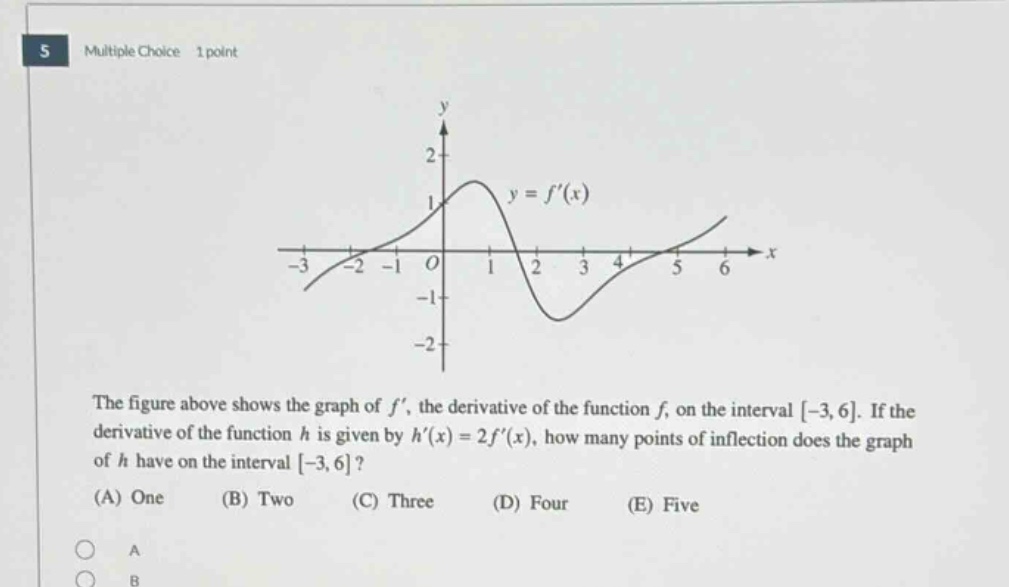
5 multiple choice 1 point the figure above shows the graph of f, the derivative of the function f, on the interval -3,6. if the derivative of the function h is given by h(x)=2f(x), how many points of inflection does the graph of h have on the interval -3,6? (a) one (b) two (c) three (d) four (e) five a b
Answer
Answer:
C. Three
Explanation:
Step1: Recall inflection - point condition
A point of inflection of the function $y = h(x)$ occurs where $h''(x)=0$ and $h''(x)$ changes sign. Given $h'(x)=2f'(x)$, then $h''(x) = 2f''(x)$. So, points of inflection of $h(x)$ occur where $f''(x)=0$ and $f''(x)$ changes sign.
Step2: Identify $f''(x) = 0$ from $f'(x)$ graph
The second - derivative $f''(x)$ is the derivative of $f'(x)$. The derivative of a function is zero at the local maxima and minima of the function. The local maxima and minima of $y = f'(x)$ occur where the slope of $y = f'(x)$ is zero.
Step3: Count local extrema of $f'(x)$
Looking at the graph of $y = f'(x)$, we can see that the slope of $y = f'(x)$ is zero at three points in the interval $[-3,6]$. These are the points where the graph of $y = f'(x)$ has a local maximum or minimum. At these points, $f''(x)=0$ and $f''(x)$ changes sign. So, the graph of $h(x)$ has three points of inflection in the interval $[-3,6]$.