1 multiple choice 1 point\nfind the best estimate for the area under the curve $f(x)=2x^{2}+3x - 1$ from…
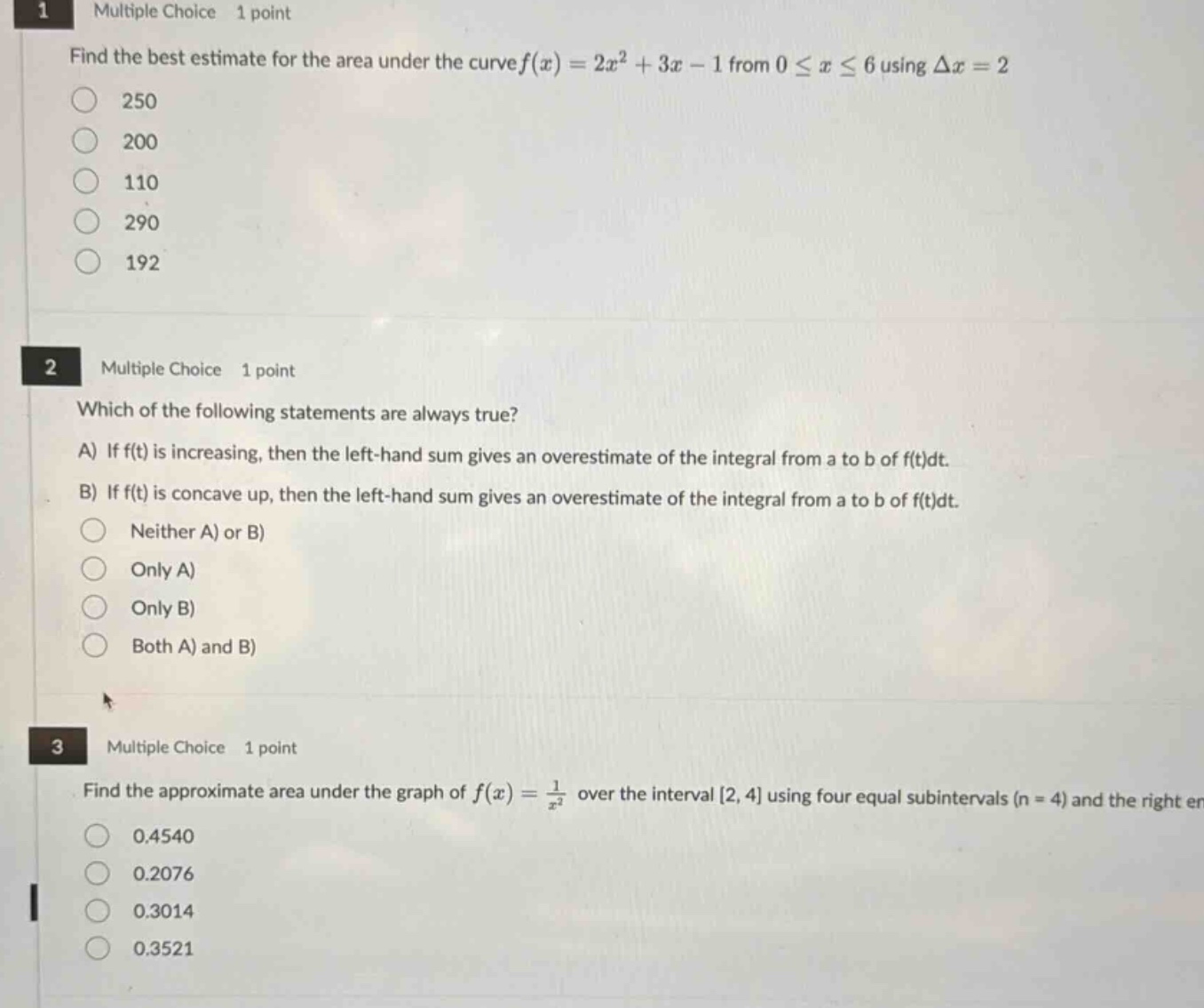
1 multiple choice 1 point\nfind the best estimate for the area under the curve $f(x)=2x^{2}+3x - 1$ from $0leq xleq6$ using $delta x = 2$\n250\n200\n110\n290\n192\n2 multiple choice 1 point\nwhich of the following statements are always true?\na) if $f(t)$ is increasing, then the left - hand sum gives an overestimate of the integral from a to b of $f(t)dt$.\nb) if $f(t)$ is concave up, then the left - hand sum gives an overestimate of the integral from a to b of $f(t)dt$.\nneither a) or b)\nonly a)\nonly b)\nboth a) and b)\n3 multiple choice 1 point\nfind the approximate area under the graph of $f(x)=\frac{1}{x^{2}}$ over the interval $2,4$ using four equal subintervals ($n = 4$) and the right en
Answer
1.
Explanation:
Step1: Determine sub - intervals
The interval is $[0,6]$ with $\Delta x = 2$. The sub - intervals are $[0,2]$, $[2,4]$, $[4,6]$.
Step2: Calculate function values at left - hand endpoints
For $x = 0$: $f(0)=2(0)^2 + 3(0)-1=-1$; for $x = 2$: $f(2)=2(2)^2+3(2)-1=8 + 6-1 = 13$; for $x = 4$: $f(4)=2(4)^2+3(4)-1=32 + 12-1=43$.
Step3: Calculate left - hand Riemann sum
$L=\sum_{i = 0}^{2}f(x_i)\Delta x=\Delta x(f(0)+f(2)+f(4))=2(-1 + 13+43)=2\times55 = 110$.
Answer:
$110$
2.
Brief Explanations:
If $f(t)$ is increasing, the left - hand sum gives an underestimate of the integral $\int_{a}^{b}f(t)dt$ because the rectangles formed by the left - hand sum are below the curve. If $f(t)$ is concave up, the left - hand sum gives an underestimate of the integral $\int_{a}^{b}f(t)dt$ since the curve lies above the tangent lines (and the left - hand sum is based on the function values at the left - hand endpoints which are lower than the curve on average for a concave - up function).
Answer:
Neither A) or B)
3.
Explanation:
Step1: Determine $\Delta x$
The interval is $[2,4]$, $n = 4$, so $\Delta x=\frac{4 - 2}{4}=0.5$. The sub - intervals are $[2,2.5]$, $[2.5,3]$, $[3,3.5]$, $[3.5,4]$.
Step2: Calculate function values at right - hand endpoints
For $x = 2.5$: $f(2.5)=\frac{1}{(2.5)^2}=\frac{1}{6.25}$; for $x = 3$: $f(3)=\frac{1}{9}$; for $x = 3.5$: $f(3.5)=\frac{1}{12.25}$; for $x = 4$: $f(4)=\frac{1}{16}$.
Step3: Calculate right - hand Riemann sum
$R=\Delta x\left(f(2.5)+f(3)+f(3.5)+f(4)\right)=0.5\left(\frac{1}{6.25}+\frac{1}{9}+\frac{1}{12.25}+\frac{1}{16}\right)$ $=0.5\left(\frac{144 + 100+72 + 56.25}{900}\right)=0.5\times\frac{372.25}{900}\approx0.2076$.
Answer:
$0.2076$