2 multiple choice 1 point. if f is the function given by f(x)=∫₄²ˣ√(t² - t) dt, then f′(2)=(a) 0 (b)…
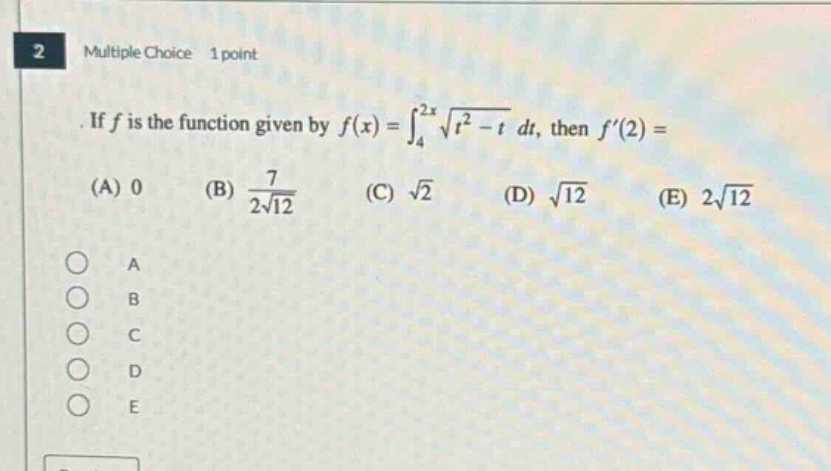
2 multiple choice 1 point. if f is the function given by f(x)=∫₄²ˣ√(t² - t) dt, then f′(2)=(a) 0 (b) 7/(2√12) (c) √2 (d) √12 (e) 2√12 a b c d e
Answer
Answer:
E. $2\sqrt{12}$
Explanation:
Step1: Apply the fundamental theorem of calculus and chain - rule
If $F(t)$ is an antiderivative of $\sqrt{t^{2}-t}$, i.e., $F^\prime(t)=\sqrt{t^{2}-t}$, then $f(x)=F(2x)-F(4)$.
Step2: Differentiate $f(x)$ with respect to $x$
By the chain - rule, $f^\prime(x)=F^\prime(2x)\cdot(2x)^\prime - 0$. Since $F^\prime(t)=\sqrt{t^{2}-t}$ and $(2x)^\prime = 2$, we have $f^\prime(x)=2\sqrt{(2x)^{2}-2x}$.
Step3: Evaluate $f^\prime(2)$
Substitute $x = 2$ into $f^\prime(x)$. Then $f^\prime(2)=2\sqrt{(2\times2)^{2}-2\times2}=2\sqrt{16 - 4}=2\sqrt{12}$.