multiple choice 1 point the function h(x)=−ln(x + 1)−2 is a transformation of the function f(x)=lnx. which…
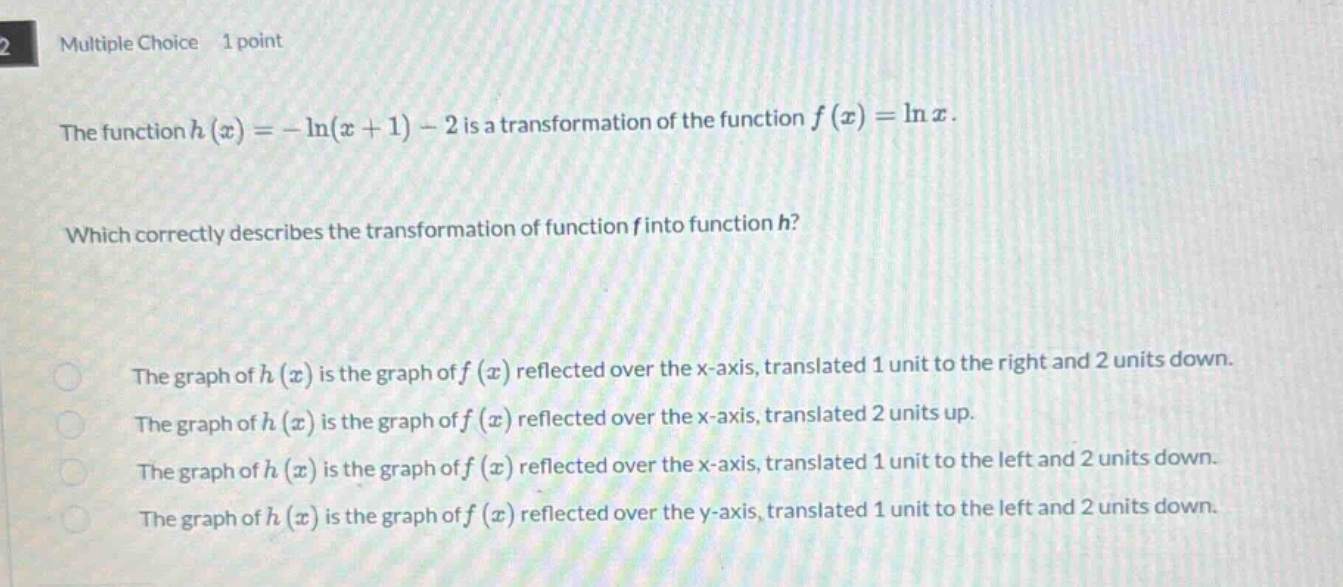
multiple choice 1 point the function h(x)=−ln(x + 1)−2 is a transformation of the function f(x)=lnx. which correctly describes the transformation of function f into function h? the graph of h(x) is the graph of f(x) reflected over the x - axis, translated 1 unit to the right and 2 units down. the graph of h(x) is the graph of f(x) reflected over the x - axis, translated 2 units up. the graph of h(x) is the graph of f(x) reflected over the x - axis, translated 1 unit to the left and 2 units down. the graph of h(x) is the graph of f(x) reflected over the y - axis, translated 1 unit to the left and 2 units down.
Answer
Explanation:
Step1: Analyze reflection
The negative sign in front of $\ln(x + 1)$ in $h(x)=-\ln(x + 1)-2$ reflects the graph of $y = \ln x$ over the $x$-axis. For a function $y = f(x)$, $y=-f(x)$ is a reflection over the $x$-axis.
Step2: Analyze horizontal - translation
For a function $y = f(x)$, the transformation $y = f(x + a)$ ($a>0$) translates the graph $a$ units to the left. In $h(x)=-\ln(x + 1)-2$, compared to $y=\ln x$, the $x$ is replaced with $x + 1$, so the graph is translated 1 unit to the left.
Step3: Analyze vertical - translation
For a function $y = f(x)$, the transformation $y=f(x)-b$ ($b > 0$) translates the graph $b$ units down. In $h(x)=-\ln(x + 1)-2$, compared to $y = \ln x$, there is a subtraction of 2, so the graph is translated 2 units down.
Answer:
The graph of $h(x)$ is the graph of $f(x)$ reflected over the $x$-axis, translated 1 unit to the left and 2 units down.