6 multiple choice 1 point let r be the region in the first quadrant bounded by the y - axis, the x - axis…
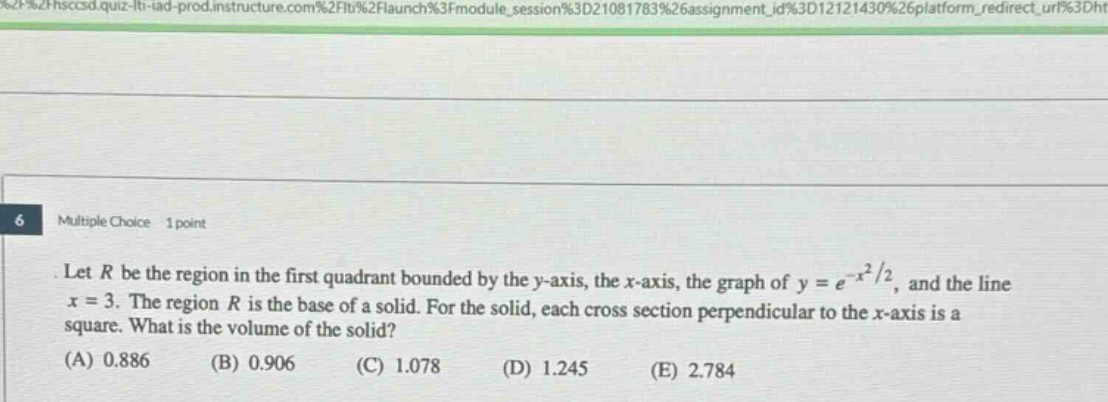
6 multiple choice 1 point let r be the region in the first quadrant bounded by the y - axis, the x - axis, the graph of y = e^(-x^2/2), and the line x = 3. the region r is the base of a solid. for the solid, each cross section perpendicular to the x - axis is a square. what is the volume of the solid? (a) 0.886 (b) 0.906 (c) 1.078 (d) 1.245 (e) 2.784
Answer
Answer:
C. 1.078
Explanation:
Step1: Recall volume - by - cross - section formula
$V=\int_{a}^{b}A(x)dx$
Step2: Find the area of the cross - section
Since the cross - section perpendicular to the $x$ - axis is a square and the side length of the square $s = e^{-x^{2}/2}$, then $A(x)=s^{2}=(e^{-x^{2}/2})^{2}=e^{-x^{2}}$.
Step3: Set up the integral for the volume
The region is bounded by $x = 0$ and $x = 3$ in the first - quadrant, so $V=\int_{0}^{3}e^{-x^{2}}dx$.
Step4: Use numerical integration
We can use a calculator with a numerical integration function (such as the fnInt function on a TI - 84 Plus) to evaluate $\int_{0}^{3}e^{-x^{2}}dx\approx1.078$.