multiple choice 1 point\nwhich slope field fits the differential equation: dy/dx=x.
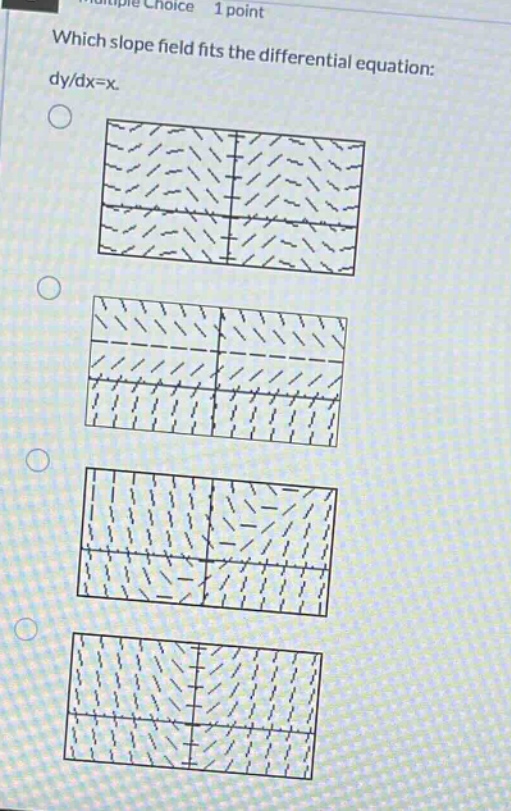
multiple choice 1 point\nwhich slope field fits the differential equation: dy/dx=x.
Answer
Explanation:
Step1: Analyze the given differential equation.
The differential equation is $\frac{dy}{dx} = x$. This means the slope of the tangent line at any point $(x, y)$ is equal to the x-coordinate of that point.
Step2: Evaluate the slope at $x=0$.
When $x=0$ (along the y-axis), the slope is $\frac{dy}{dx} = 0$. The line segments in the slope field should be horizontal along the y-axis.
Step3: Evaluate the slope for $x > 0$.
When $x > 0$ (to the right of the y-axis), the slope $\frac{dy}{dx} = x$ is positive. The line segments should have positive slopes, becoming steeper as $x$ increases.
Step4: Evaluate the slope for $x < 0$.
When $x < 0$ (to the left of the y-axis), the slope $\frac{dy}{dx} = x$ is negative. The line segments should have negative slopes, becoming steeper downwards as $x$ becomes more negative.
Step5: Check dependence on $y$.
The slope $\frac{dy}{dx} = x$ does not depend on $y$. Therefore, for any fixed value of $x$, the slopes should be the same for all values of $y$. This means the line segments along any vertical line should be parallel.
Step6: Compare with the options.
Examine the four slope fields provided:
- The first option shows slopes depending on $y$.
- The second option shows horizontal slopes at $x=0$, positive slopes for $x>0$ (increasing steepness with $x$), negative slopes for $x<0$ (increasing steepness downwards as $x$ decreases), and slopes are constant along vertical lines. This matches our analysis.
- The third option shows slopes that are not horizontal at $x=0$.
- The fourth option shows slopes depending on both $x$ and $y$.
Therefore, the second slope field correctly represents the differential equation $\frac{dy}{dx} = x$.
Answer:
The correct option is the second slope field.