multiple choice 1 point\nthe table above shows several riemann sum approximations to ∫₀¹(1/x)dx using right…
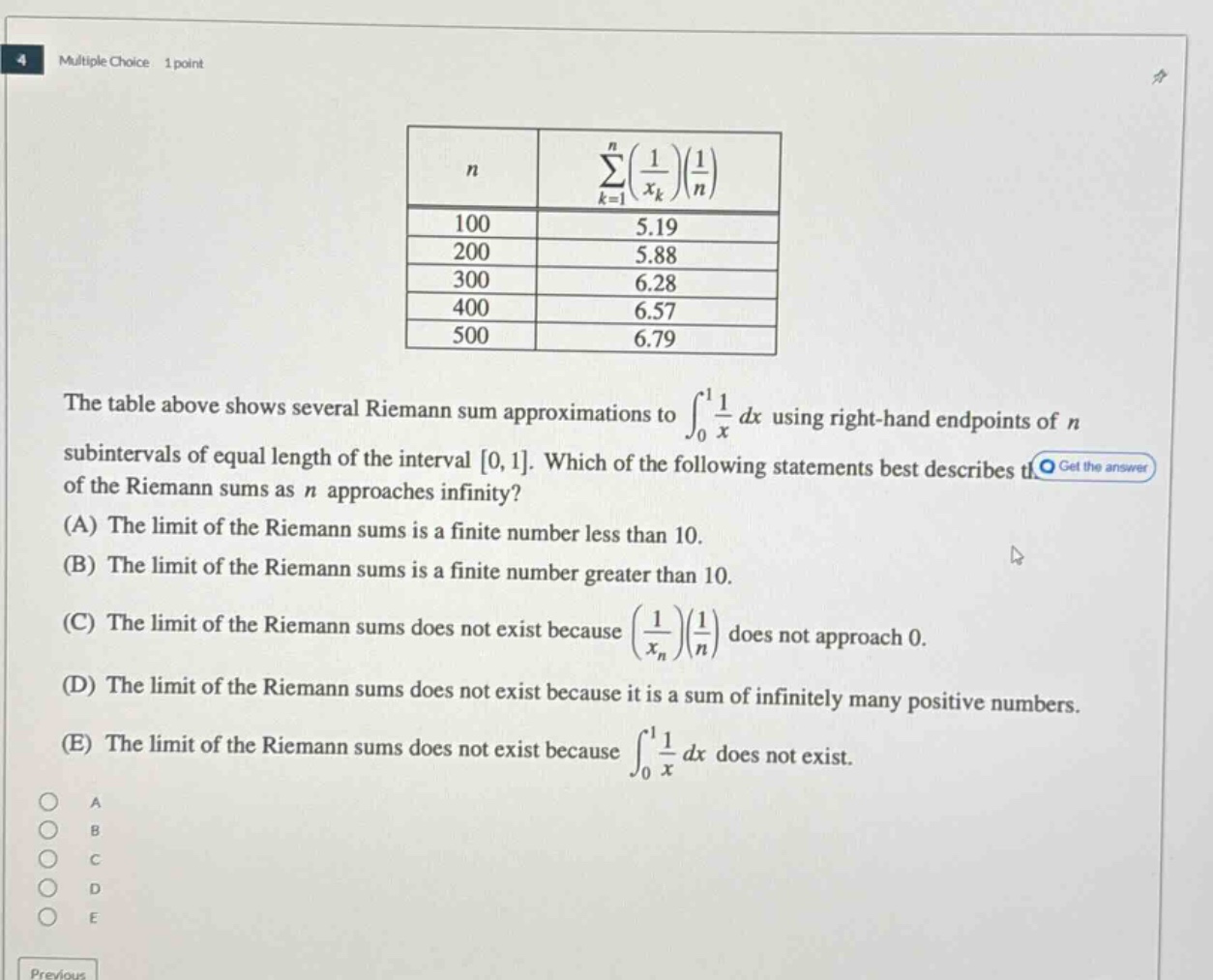
multiple choice 1 point\nthe table above shows several riemann sum approximations to ∫₀¹(1/x)dx using right - hand endpoints of n subintervals of equal length of the interval 0,1. which of the following statements best describes the of the riemann sums as n approaches infinity?\n(a) the limit of the riemann sums is a finite number less than 10.\n(b) the limit of the riemann sums is a finite number greater than 10.\n(c) the limit of the riemann sums does not exist because (1/xₙ)(1/n) does not approach 0.\n(d) the limit of the riemann sums does not exist because it is a sum of infinitely many positive numbers.\n(e) the limit of the riemann sums does not exist because ∫₀¹(1/x)dx does not exist.\na\nb\nc\nd\ne
Answer
Answer:
E. The limit of the Riemann sums does not exist because $\int_{0}^{1}\frac{1}{x}dx$ does not exist.
Explanation:
Step1: Recall integral - Riemann sum relationship
The Riemann sum $\sum_{k = 1}^{n}(\frac{1}{x_k})(\frac{1}{n})$ with right - hand endpoints on $[0,1]$ is an approximation of $\int_{0}^{1}\frac{1}{x}dx$.
Step2: Analyze the integral $\int_{0}^{1}\frac{1}{x}dx$
We know that $\int\frac{1}{x}dx=\ln|x|+C$. Then $\int_{0}^{1}\frac{1}{x}dx=\lim_{a\rightarrow0^{+}}\int_{a}^{1}\frac{1}{x}dx=\lim_{a\rightarrow0^{+}}(\ln(1)-\ln(a))=\lim_{a\rightarrow0^{+}}(-\ln(a))=\infty$.
Step3: Conclusion
Since the definite integral $\int_{0}^{1}\frac{1}{x}dx$ does not exist (it is an improper integral that diverges), the limit of the Riemann sums as $n\rightarrow\infty$ does not exist.