multiply/divide in scientific notation\nscore: 1/5 penalty: 1 off\nquestion\nwatch video show examples\nwhat…
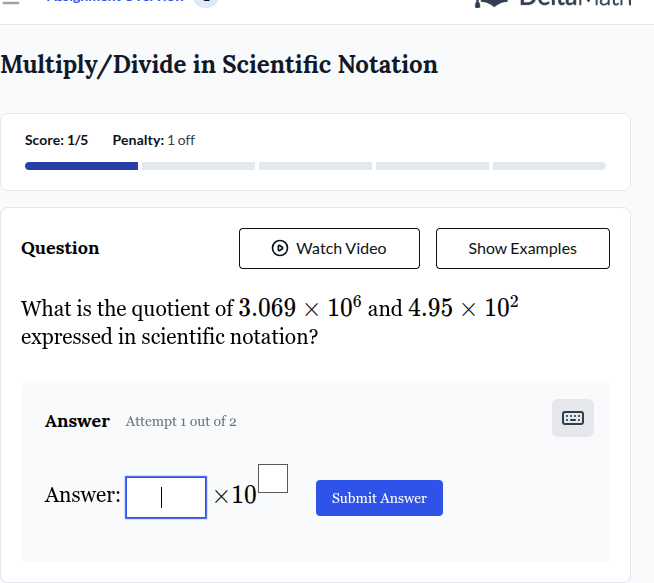
multiply/divide in scientific notation\nscore: 1/5 penalty: 1 off\nquestion\nwatch video show examples\nwhat is the quotient of $3.069 \\times 10^6$ and $4.95 \\times 10^2$ expressed in scientific notation?\nanswer attempt 1 out of 2\nanswer: \\(\\square \\times 10^{\\square}\\) submit answer
Answer
Explanation:
Step1: Divide the coefficients
To find the quotient of the two numbers in scientific notation, we first divide the coefficients (the parts before the powers of 10). So we calculate $\frac{3.069}{4.95}$. [ \frac{3.069}{4.95} = 0.62 ] Wait, no, let's do the division correctly. (3.069\div4.95): [ 3.069\div4.95 = \frac{3.069}{4.95} = 0.62? \text{ Wait, no, } 4.95\times0.62 = 3.069? Let's check: 4.95\times0.6 = 2.97, 4.95\times0.02 = 0.099, so 2.97 + 0.099 = 3.069. Yes, so (\frac{3.069}{4.95}=0.62)? Wait, no, 3.069 divided by 4.95: Let's do it as (3.069\div4.95). Multiply numerator and denominator by 1000 to eliminate decimals: (3069\div4950). Simplify this fraction. Divide numerator and denominator by 3: (1023\div1650). Divide by 3 again: (341\div550). Wait, maybe I made a mistake earlier. Wait, 4.95 times 0.62 is 3.069? Let's calculate 4.95 * 0.62: 4 * 0.62 = 2.48, 0.95 * 0.62 = 0.589, so 2.48 + 0.589 = 3.069. Yes, so that's correct. So the coefficient division gives 0.62? Wait, no, wait, 3.069 divided by 4.95: Wait, 3.069 ÷ 4.95. Let's write it as (3.069) ÷ (4.95). Let's move the decimal in both numbers: 30.69 ÷ 49.5 (multiply numerator and denominator by 10). Then 30.69 ÷ 49.5. Let's do this division: 49.5 goes into 30.69 zero times. Add a decimal point, 49.5 goes into 306.9 six times (49.5*6=297), subtract 297 from 306.9, we get 9.9. Bring down a zero: 99.0. 49.5 goes into 99.0 exactly 2 times. So 0.62. So the coefficient is 0.62? Wait, but in scientific notation, the coefficient should be between 1 and 10. So we need to adjust it.
Step2: Divide the powers of 10
Next, we divide the powers of 10. When dividing numbers in scientific notation, we subtract the exponents. So for (10^6) and (10^2), we have (10^{6 - 2}=10^4).
Step3: Adjust the coefficient to be in scientific notation
Now, we have the result from step 1: 0.62 and from step 2: (10^4). But 0.62 is not between 1 and 10, so we need to adjust it. We can write 0.62 as (6.2\times10^{-1}). Then multiply this by (10^4):
[ (6.2\times10^{-1})\times10^4 = 6.2\times10^{-1 + 4}=6.2\times10^3 ]
Wait, wait, let's go back. Wait, maybe I made a mistake in step 1. Let's recalculate the coefficient division:
(3.069\div4.95):
Let's do this division properly. 4.95 × 0.6 = 2.97, 3.069 - 2.97 = 0.099. Then 0.099 ÷ 4.95 = 0.02. So total is 0.6 + 0.02 = 0.62. Then, to get the coefficient between 1 and 10, we write 0.62 as 6.2 × 10⁻¹. Then multiply by 10⁴ (from the exponent subtraction: 6 - 2 = 4). So 6.2 × 10⁻¹ × 10⁴ = 6.2 × 10^( -1 + 4 ) = 6.2 × 10³.
Wait, let's check: 6.2 × 10³ = 6200. Now, let's check the original division: (3.069 × 10⁶) ÷ (4.95 × 10²) = (3.069 ÷ 4.95) × 10^(6 - 2) = 0.62 × 10⁴ = 6.2 × 10³ (since 0.62 × 10⁴ = 6.2 × 10³). Yes, that's correct.
Wait, let's verify with actual numbers. 3.069 × 10⁶ is 3,069,000. 4.95 × 10² is 495. Now, divide 3,069,000 by 495:
3,069,000 ÷ 495. Let's divide numerator and denominator by 15: 3,069,000 ÷15=204,600; 495 ÷15=33. Now 204,600 ÷33. 33 × 6000=198,000. 204,600 - 198,000=6,600. 6,600 ÷33=200. So total is 6000 + 200=6200. 6200 in scientific notation is 6.2 × 10³. Yes, that's correct. So the coefficient is 6.2 and the exponent is 3.
Answer:
(6.2 \times 10^{3})