name date period 94) an astronaut drops a rock off the edge of a cliff on the moon. the distance, d(t), in…
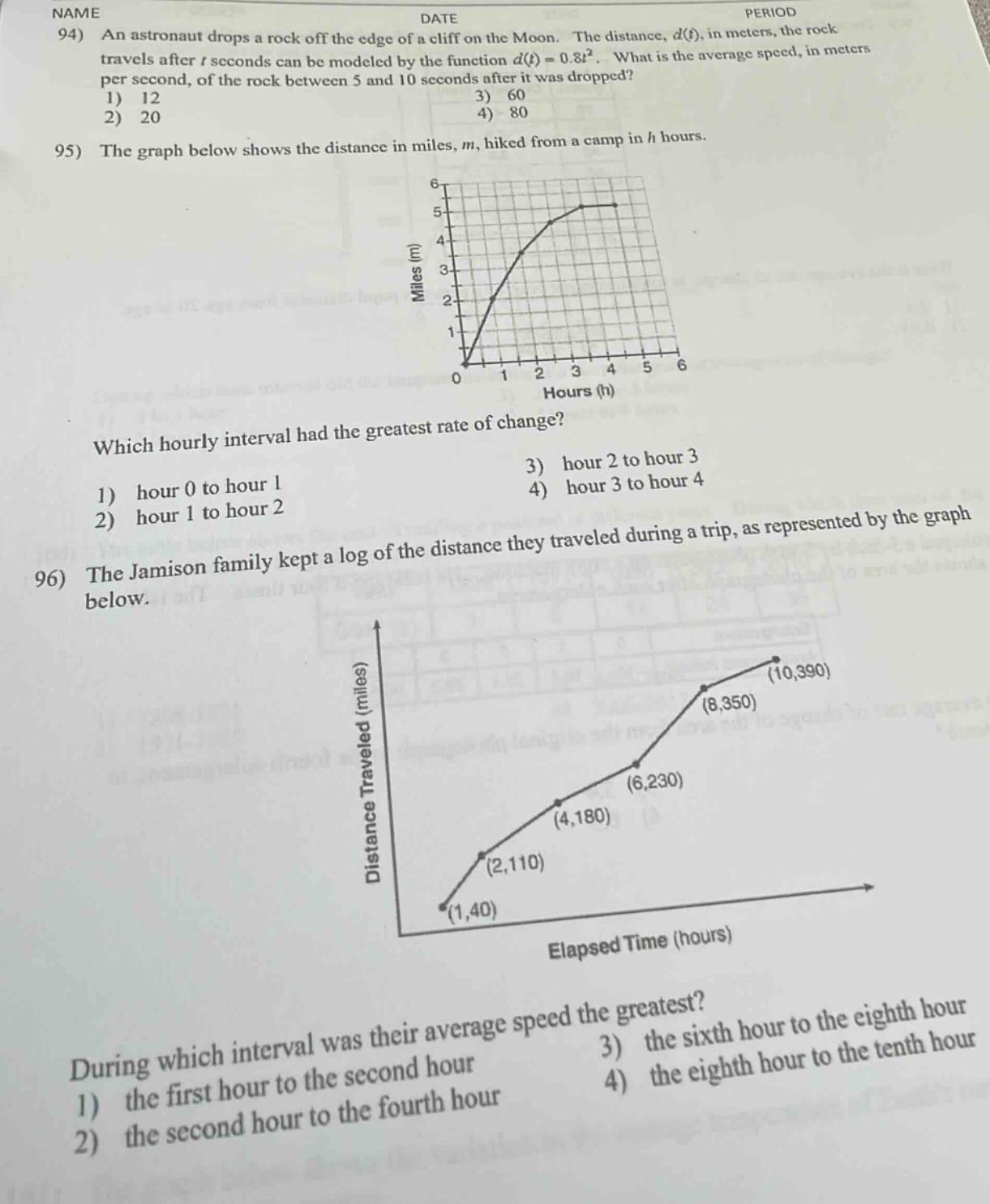
name date period 94) an astronaut drops a rock off the edge of a cliff on the moon. the distance, d(t), in meters, the rock travels after t seconds can be modeled by the function d(t)=0.8t². what is the average speed, in meters per second, of the rock between 5 and 10 seconds after it was dropped? 1) 12 2) 20 3) 60 4) 80 95) the graph below shows the distance in miles, m, hiked from a camp in h hours. which hourly interval had the greatest rate of change? 1) hour 0 to hour 1 2) hour 1 to hour 2 3) hour 2 to hour 3 4) hour 3 to hour 4 96) the jamison family kept a log of the distance they traveled during a trip, as represented by the graph below. during which interval was their average speed the greatest? 1) the first hour to the second hour 2) the second hour to the fourth hour 3) the sixth hour to the eighth hour 4) the eighth hour to the tenth hour
Answer
Explanation:
Step1: Find distance at (t = 5)
Substitute (t = 5) into (d(t)=0.8t^{2}). So (d(5)=0.8\times5^{2}=0.8\times25 = 20).
Step2: Find distance at (t = 10)
Substitute (t = 10) into (d(t)=0.8t^{2}). So (d(10)=0.8\times10^{2}=0.8\times100 = 80).
Step3: Calculate average - speed
The formula for average speed (v_{avg}=\frac{d(t_2)-d(t_1)}{t_2 - t_1}). Here (t_1 = 5), (t_2 = 10), (d(t_1)=20), (d(t_2)=80). Then (v_{avg}=\frac{80 - 20}{10 - 5}=\frac{60}{5}=12).
Answer:
- 12
For question 95:
Explanation:
The rate of change of a function (y = f(x)) over an interval ([x_1,x_2]) is given by (\frac{f(x_2)-f(x_1)}{x_2 - x_1}).
Step1: Calculate rate of change for hour 0 - 1
From the graph, at (h = 0), (m = 0); at (h = 1), (m = 2). Rate of change (=\frac{2 - 0}{1-0}=2).
Step2: Calculate rate of change for hour 1 - 2
At (h = 1), (m = 2); at (h = 2), (m = 4). Rate of change (=\frac{4 - 2}{2 - 1}=2).
Step3: Calculate rate of change for hour 2 - 3
At (h = 2), (m = 4); at (h = 3), (m = 5). Rate of change (=\frac{5 - 4}{3 - 2}=1).
Step4: Calculate rate of change for hour 3 - 4
At (h = 3), (m = 5); at (h = 4), (m = 5). Rate of change (=\frac{5 - 5}{4 - 3}=0).
Answer:
- hour 0 to hour 1, 2) hour 1 to hour 2
For question 96:
Explanation:
The average - speed (v_{avg}=\frac{\Delta d}{\Delta t}), where (\Delta d) is the change in distance and (\Delta t) is the change in time.
Step1: Calculate average speed for first - second hour
At (t = 1), (d = 40); at (t = 2), (d = 110). (v_{avg1}=\frac{110 - 40}{2 - 1}=70).
Step2: Calculate average speed for second - fourth hour
At (t = 2), (d = 110); at (t = 4), (d = 180). (v_{avg2}=\frac{180 - 110}{4 - 2}=\frac{70}{2}=35).
Step3: Calculate average speed for sixth - eighth hour
At (t = 6), (d = 230); at (t = 8), (d = 350). (v_{avg3}=\frac{350 - 230}{8 - 6}=\frac{120}{2}=60).
Step4: Calculate average speed for eighth - tenth hour
At (t = 8), (d = 350); at (t = 10), (d = 390). (v_{avg4}=\frac{390 - 350}{10 - 8}=\frac{40}{2}=20).
Answer:
- the sixth hour to the eighth hour