name: graphing sine and cosine functions #1 graph the given functions. label the intervals on the axes and…
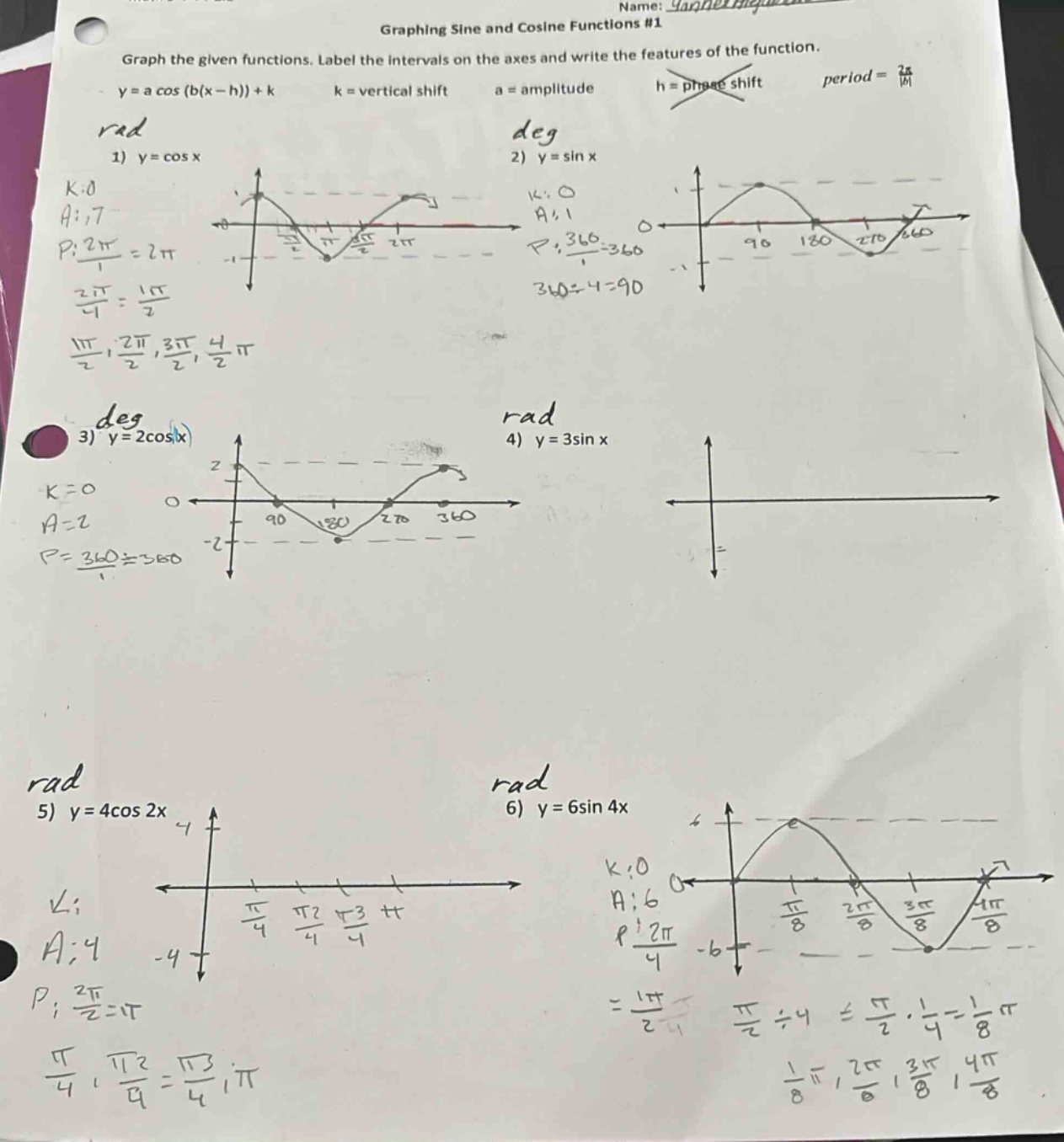
name: graphing sine and cosine functions #1 graph the given functions. label the intervals on the axes and write the features of the function. y = a cos (b(x - h)) + k k = vertical shift a = amplitude h = phase shift period = 2π/|b| rad deg 1) y = cos x 2) y = sin x k:0 k:0 a:1 a:1 p:2π/1 = 2π p:360/1 = 360 2π/4 = π/2 360÷4 = 90 π/2, 2π/2, 3π/2, 4π/2 deg rad 3) y = 2cos(x) 4) y = 3sin x k = 0 a = 2 p = 360÷1 = 360 rad rad 5) y = 4cos 2x 6) y = 6sin 4x k:0 a:4 a:6 p:2π/2 = π p:2π/4 = π/2 π/4, π/2 = 2π/4, 3π/4, π π/8, 2π/8, 3π/8, 4π/8
Answer
Explanation:
Step1: Identify the general form
The general form of a sinusoidal - type function is $y = a\cos(b(x - h))+k$ (for cosine) and $y=a\sin(b(x - h))+k$ (for sine), where $a$ is the amplitude, $b$ affects the period ($P=\frac{2\pi}{|b|}$ for radians and $P = \frac{360^{\circ}}{|b|}$ for degrees), $h$ is the phase - shift, and $k$ is the vertical shift.
Step2: Analyze $y = \cos x$
For $y=\cos x$, $a = 1$, $b = 1$, $h = 0$, $k = 0$. Amplitude $A=1$, period $P=\frac{2\pi}{1}=2\pi$ (in radians) or $P = 360^{\circ}$ (in degrees).
Step3: Analyze $y=\sin x$
For $y=\sin x$, $a = 1$, $b = 1$, $h = 0$, $k = 0$. Amplitude $A = 1$, period $P=\frac{2\pi}{1}=2\pi$ (in radians) or $P = 360^{\circ}$ (in degrees).
Step4: Analyze $y = 2\cos x$
For $y = 2\cos x$, $a = 2$, $b = 1$, $h = 0$, $k = 0$. Amplitude $A = 2$, period $P=\frac{2\pi}{1}=2\pi$ (in radians) or $P = 360^{\circ}$ (in degrees).
Step5: Analyze $y = 3\sin x$
For $y = 3\sin x$, $a = 3$, $b = 1$, $h = 0$, $k = 0$. Amplitude $A = 3$, period $P=\frac{2\pi}{1}=2\pi$ (in radians) or $P = 360^{\circ}$ (in degrees).
Step6: Analyze $y = 4\cos2x$
For $y = 4\cos2x$, $a = 4$, $b = 2$, $h = 0$, $k = 0$. Amplitude $A = 4$, period $P=\frac{2\pi}{2}=\pi$ (in radians).
Step7: Analyze $y = 6\sin4x$
For $y = 6\sin4x$, $a = 6$, $b = 4$, $h = 0$, $k = 0$. Amplitude $A = 6$, period $P=\frac{2\pi}{4}=\frac{\pi}{2}$ (in radians).
The features of each function are as follows:
- $y=\cos x$:
- Amplitude $A = 1$
- Period $P = 2\pi$ (radians) or $360^{\circ}$ (degrees)
- Vertical shift $k = 0$
- Phase - shift $h = 0$
- $y=\sin x$:
- Amplitude $A = 1$
- Period $P = 2\pi$ (radians) or $360^{\circ}$ (degrees)
- Vertical shift $k = 0$
- Phase - shift $h = 0$
- $y = 2\cos x$:
- Amplitude $A = 2$
- Period $P = 2\pi$ (radians) or $360^{\circ}$ (degrees)
- Vertical shift $k = 0$
- Phase - shift $h = 0$
- $y = 3\sin x$:
- Amplitude $A = 3$
- Period $P = 2\pi$ (radians) or $360^{\circ}$ (degrees)
- Vertical shift $k = 0$
- Phase - shift $h = 0$
- $y = 4\cos2x$:
- Amplitude $A = 4$
- Period $P=\pi$ (radians)
- Vertical shift $k = 0$
- Phase - shift $h = 0$
- $y = 6\sin4x$:
- Amplitude $A = 6$
- Period $P=\frac{\pi}{2}$ (radians)
- Vertical shift $k = 0$
- Phase - shift $h = 0$
To graph these functions:
- For $y = a\cos(bx)$ or $y = a\sin(bx)$:
- Mark the key points. For a cosine function $y=\cos x$, the key points in one period $[0,2\pi]$ are $(0,1),(\frac{\pi}{2},0),(\pi, - 1),(\frac{3\pi}{2},0),(2\pi,1)$. For a sine function $y=\sin x$, the key points in one period $[0,2\pi]$ are $(0,0),(\frac{\pi}{2},1),(\pi,0),(\frac{3\pi}{2}, - 1),(2\pi,0)$.
- When $|a|>1$, the amplitude increases, stretching the graph vertically. When $|b|>1$, the period decreases, compressing the graph horizontally.
Answer:
The features and graphing instructions for the functions $y=\cos x,y=\sin x,y = 2\cos x,y = 3\sin x,y = 4\cos2x,y = 6\sin4x$ are provided above.