name: intro to asymptotes edpuzzles: notes page edpuzzle #1 - vertical asymptotes 1. f(x)=1/(x - 3) va @ x…
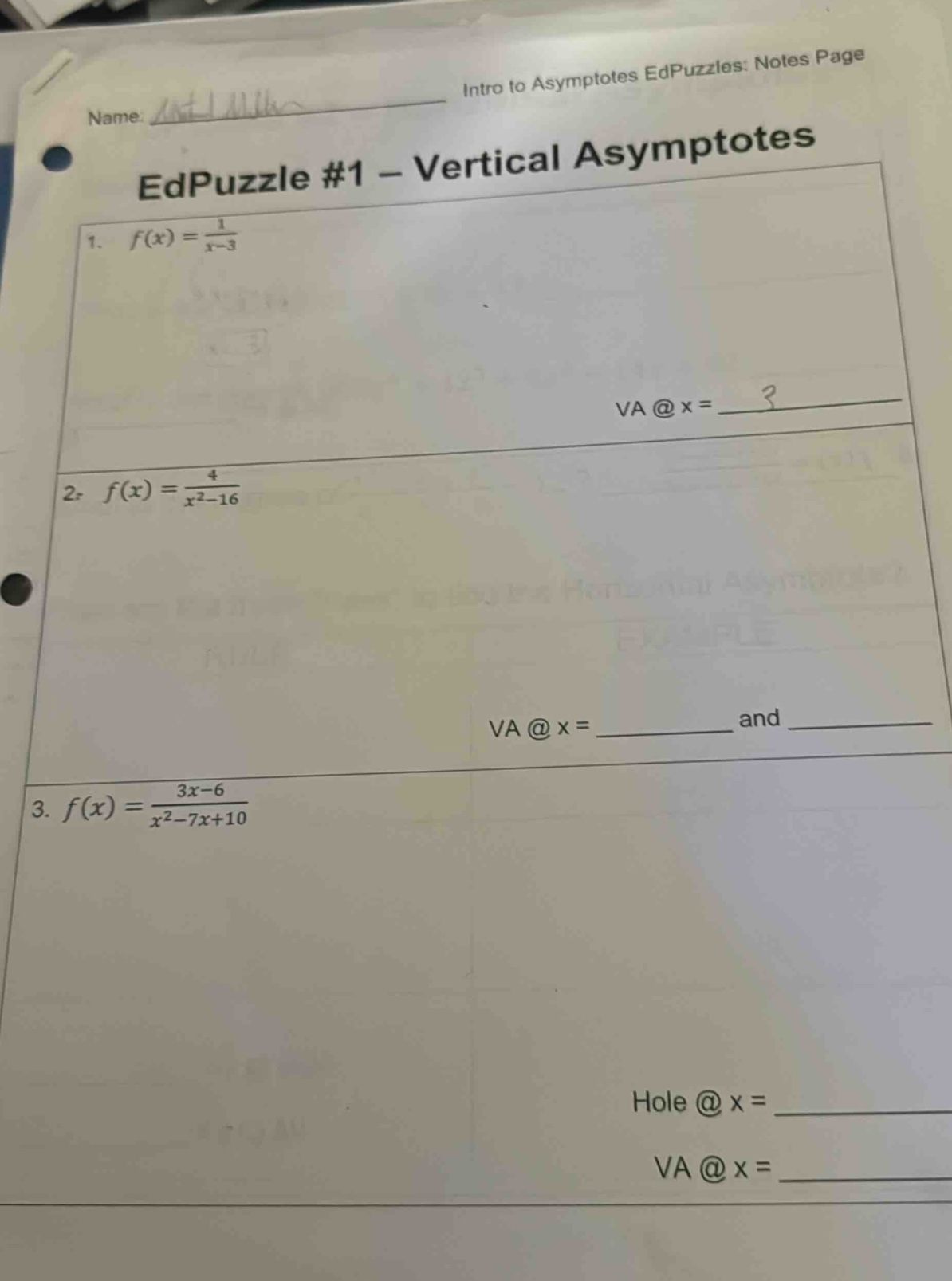
name: intro to asymptotes edpuzzles: notes page edpuzzle #1 - vertical asymptotes 1. f(x)=1/(x - 3) va @ x =? 2. f(x)=4/(x² - 16) va @ x = and 3. f(x)=(3x - 6)/(x² - 7x + 10) hole @ x = va @ x =
Answer
Explanation:
Step1: Recall vertical - asymptote rule
Vertical asymptotes occur where the denominator of a rational function is zero and the numerator is non - zero.
Step2: For (f(x)=\frac{1}{x - 3})
Set the denominator equal to zero: (x-3 = 0), so (x = 3).
Step3: For (f(x)=\frac{4}{x^{2}-16})
Factor the denominator (x^{2}-16=(x + 4)(x - 4)). Set ((x + 4)(x - 4)=0). Then (x=-4) and (x = 4).
Step4: For (f(x)=\frac{3x - 6}{x^{2}-7x + 10})
Factor the numerator (3x-6=3(x - 2)) and the denominator (x^{2}-7x + 10=(x - 2)(x - 5)). Cancel out the common factor ((x - 2)). There is a hole at (x = 2) (since the factor cancels). Set the non - canceled part of the denominator (x-5=0), so the vertical asymptote is (x = 5).
Answer:
- (x = 3)
- (x=-4), (x = 4)
- Hole @ (x = 2), VA @ (x = 5)