name raymond ouse period 4.5 ws #1 pre calc determine the amplitude and period of each function. (write…
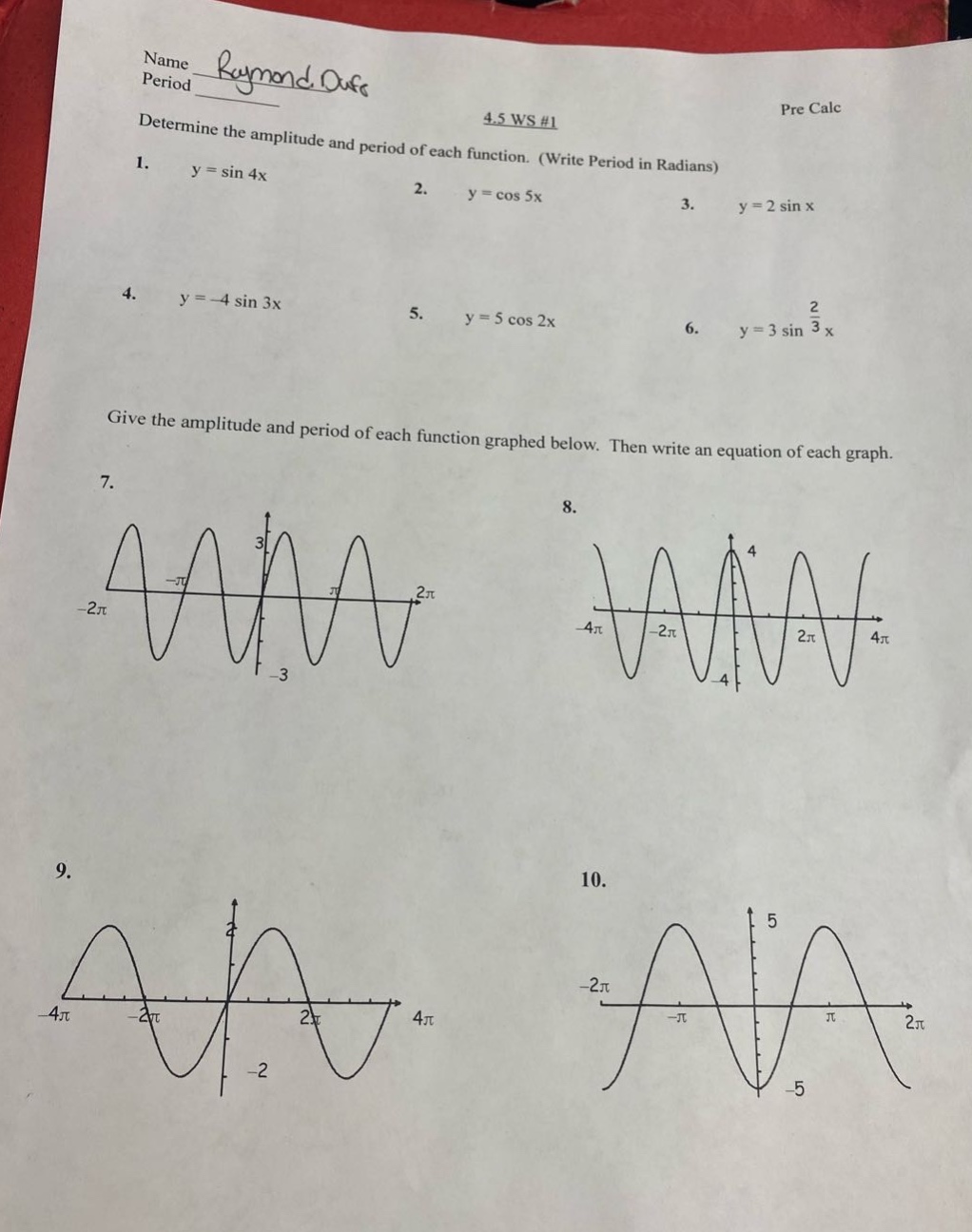
name raymond ouse period 4.5 ws #1 pre calc determine the amplitude and period of each function. (write period in radians) 1. y = sin 4x 2. y = cos 5x 3. y = 2 sin x 4. y = -4 sin 3x 5. y = 5 cos 2x 6. y = 3 sin 2/3 x give the amplitude and period of each function graphed below. then write an equation of each graph. 7. 8. 9. 10.
Answer
- For (y = \sin4x):
- Explanation:
- Step1: Recall the general form of a sine - function (y = A\sin(Bx)) and amplitude formula:
- The general form of a sine function is (y = A\sin(Bx)), where the amplitude (|A|). For (y=\sin4x), (A = 1), so the amplitude (|A|=1).
- Step2: Recall the period formula for (y = A\sin(Bx)):
- The period (T) of the function (y = A\sin(Bx)) is given by (T=\frac{2\pi}{|B|}). Here (B = 4), so (T=\frac{2\pi}{4}=\frac{\pi}{2}).
- Step1: Recall the general form of a sine - function (y = A\sin(Bx)) and amplitude formula:
- Answer: Amplitude: (1), Period: (\frac{\pi}{2})
- Explanation:
- For (y=\cos5x):
- Explanation:
- Step1: Recall the general form of a cosine - function (y = A\cos(Bx)) and amplitude formula:
- The general form of a cosine function is (y = A\cos(Bx)), and the amplitude is (|A|). For (y = \cos5x), (A = 1), so the amplitude (|A|=1).
- Step2: Recall the period formula for (y = A\cos(Bx)):
- The period (T) of the function (y = A\cos(Bx)) is (T=\frac{2\pi}{|B|}). Since (B = 5), (T=\frac{2\pi}{5}).
- Step1: Recall the general form of a cosine - function (y = A\cos(Bx)) and amplitude formula:
- Answer: Amplitude: (1), Period: (\frac{2\pi}{5})
- Explanation:
- For (y = 2\sin x):
- Explanation:
- Step1: Determine the amplitude:
- For the function (y = 2\sin x) (in the form (y = A\sin(Bx)) with (A = 2) and (B = 1)), the amplitude (|A|=2).
- Step2: Determine the period:
- Using the period formula (T=\frac{2\pi}{|B|}), with (B = 1), we get (T = 2\pi).
- Step1: Determine the amplitude:
- Answer: Amplitude: (2), Period: (2\pi)
- Explanation:
- For (y=-4\sin3x):
- Explanation:
- Step1: Find the amplitude:
- For the function (y=-4\sin3x) (where (A=-4) and (B = 3) in (y = A\sin(Bx))), the amplitude (|A| = 4).
- Step2: Find the period:
- Using the period formula (T=\frac{2\pi}{|B|}), with (B = 3), we have (T=\frac{2\pi}{3}).
- Step1: Find the amplitude:
- Answer: Amplitude: (4), Period: (\frac{2\pi}{3})
- Explanation:
- For (y = 5\cos2x):
- Explanation:
- Step1: Determine the amplitude:
- For the function (y = 5\cos2x) (in the form (y = A\cos(Bx)) with (A = 5) and (B = 2)), the amplitude (|A|=5).
- Step2: Determine the period:
- Using the period formula (T=\frac{2\pi}{|B|}), with (B = 2), we get (T=\pi).
- Step1: Determine the amplitude:
- Answer: Amplitude: (5), Period: (\pi)
- Explanation:
- For (y = 3\sin\frac{2}{3}x):
- Explanation:
- Step1: Find the amplitude:
- For the function (y = 3\sin\frac{2}{3}x) (where (A = 3) and (B=\frac{2}{3}) in (y = A\sin(Bx))), the amplitude (|A| = 3).
- Step2: Find the period:
- Using the period formula (T=\frac{2\pi}{|B|}), with (B=\frac{2}{3}), we have (T=\frac{2\pi}{\frac{2}{3}}=3\pi).
- Step1: Find the amplitude:
- Answer: Amplitude: (3), Period: (3\pi)
- Explanation:
7 - 10: 7. For the first graph:
- Explanation:
- Step1: Determine the amplitude:
- The maximum value of the function is (3) and the minimum is (- 3), so the amplitude (A = 3).
- Step2: Determine the period:
- The function repeats itself over an interval of length (\pi), so the period (T=\pi).
- Step3: Write the equation:
- The general form of a sine - type function is (y = A\sin(Bx)) (since it passes through the origin). Since (A = 3) and (T=\frac{2\pi}{B}=\pi), then (B = 2). The equation is (y = 3\sin2x).
- Step1: Determine the amplitude:
- Answer: Amplitude: (3), Period: (\pi), Equation: (y = 3\sin2x)
- For the second graph:
- Explanation:
- Step1: Determine the amplitude:
- The maximum value of the function is (4) and the minimum is (-4), so the amplitude (A = 4).
- Step2: Determine the period:
- The function repeats itself over an interval of length (2\pi), so the period (T = 2\pi).
- Step3: Write the equation:
- The general form of a cosine - type function (since it has a maximum at (x = 0)) is (y=A\cos(Bx)). Since (A = 4) and (B = 1) (because (T=\frac{2\pi}{B}=2\pi)), the equation is (y = 4\cos x).
- Step1: Determine the amplitude:
- Answer: Amplitude: (4), Period: (2\pi), Equation: (y = 4\cos x)
- Explanation:
- For the third graph:
- Explanation:
- Step1: Determine the amplitude:
- The maximum value of the function is (2) and the minimum is (-2), so the amplitude (A = 2).
- Step2: Determine the period:
- The function repeats itself over an interval of length (4\pi), so the period (T = 4\pi).
- Step3: Write the equation:
- The general form of a sine - type function (since it passes through the origin) is (y = A\sin(Bx)). Since (A = 2) and (T=\frac{2\pi}{B}=4\pi), then (B=\frac{1}{2}). The equation is (y = 2\sin\frac{1}{2}x).
- Step1: Determine the amplitude:
- Answer: Amplitude: (2), Period: (4\pi), Equation: (y = 2\sin\frac{1}{2}x)
- Explanation:
- For the fourth graph:
- Explanation:
- Step1: Determine the amplitude:
- The maximum value of the function is (5) and the minimum is (-5), so the amplitude (A = 5).
- Step2: Determine the period:
- The function repeats itself over an interval of length (2\pi), so the period (T = 2\pi).
- Step3: Write the equation:
- The general form of a cosine - type function (since it has a minimum at (x = 0)) is (y=-A\cos(Bx)). Since (A = 5) and (B = 1) (because (T=\frac{2\pi}{B}=2\pi)), the equation is (y=-5\cos x).
- Step1: Determine the amplitude:
- Answer: Amplitude: (5), Period: (2\pi), Equation: (y=-5\cos x)