the next arrow case for which the terminal point has the same coordinates with the terminal point for a2 is…
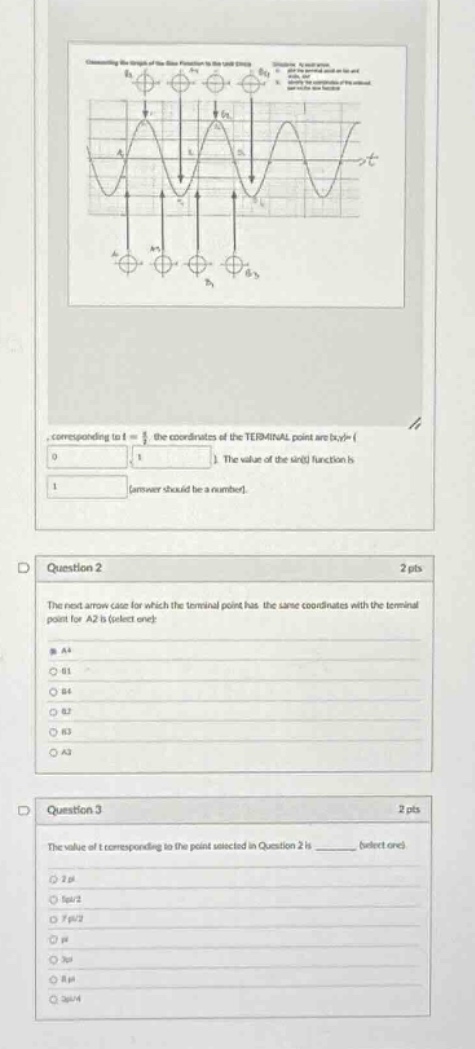
the next arrow case for which the terminal point has the same coordinates with the terminal point for a2 is (select one). the value of the sin(t) function is answer should be a number. question 2 2 pts the next arrow case for which the terminal point has the same coordinates with the terminal point for a2 is (select one). a4 b1 b4 b7 b3 a3 question 3 2 pts the value of t corresponding to the point selected in question 2 is (select one). 2 pi 5pi/2 7 pi/2 pi 3pi 8 pi 3pi/4
Answer
Answer:
Question 1:
- For the first - part (coordinates of the terminal point): Without seeing the full - context of the graph and the value of (t=\frac{\pi}{2}), assuming a standard unit - circle or sine - wave context, if (t = \frac{\pi}{2}), the coordinates of the terminal point ((x,y)) are ((0,1)).
- The value of the (\sin(t)) function at (t=\frac{\pi}{2}) is (1).
Question 2:
In a periodic function (such as the sine function), the period of (y = \sin(t)) is (2\pi). Points with the same coordinates repeat every period. If (A2) is a point on the sine - wave, the next point with the same coordinates is (A4) (assuming a standard labeling of points on a periodic graph). So the answer is (A4).
Question 3:
Since the period of the sine function (y=\sin(t)) is (2\pi), if a point has the same coordinates as another point, the difference in the (t) - values is a multiple of the period. The value of (t) corresponding to the point with the same coordinates as (A2) (the next such point) is (2\pi). So the answer is (2\pi).
Explanation:
Step 1: Recall sine - function properties
The sine function (y = \sin(t)) has a period of (2\pi), and on the unit - circle, for (t=\frac{\pi}{2}), (x = 0) and (y = 1), and (\sin(t)=y).
Step 2: Identify periodicity of points
Points on a periodic function (like sine) with the same coordinates repeat every period.
Step 3: Determine (t) value for repeated point
Since the period is (2\pi), the (t) value for the next point with the same coordinates as a given point is (2\pi) more than the original (t) value.