nml - district assessment trig review\nname: \ndirections: define the following words below:\n1) midline…
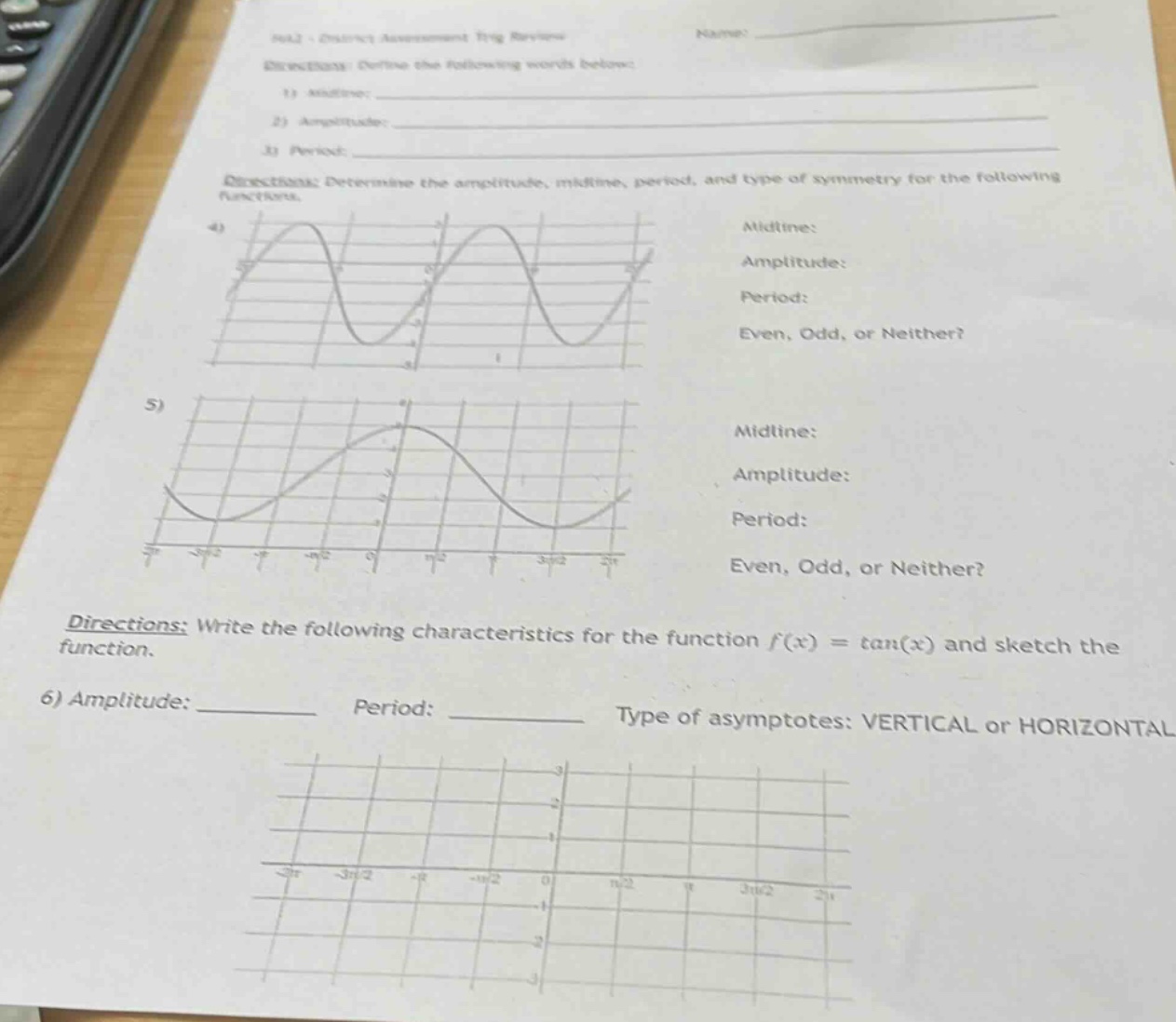
nml - district assessment trig review\nname: \ndirections: define the following words below:\n1) midline: \n2) amplitude: \n3) period: \ndirections: determine the amplitude, midline, period, and type of symmetry for the following functions.\n4) \nmidline: \namplitude: \nperiod: \neven, odd, or neither?\n5) \nmidline: \namplitude: \nperiod: \neven, odd, or neither?\ndirections: write the following characteristics for the function f(x)=tan(x) and sketch the function.\n6) amplitude: ________ period: ________ type of asymptotes: vertical or horizontal
Answer
Explanation:
Step1: Define midline
The mid - line of a periodic function is the horizontal line $y = k$ about which the function oscillates. For a sine or cosine function of the form $y = A\sin(Bx - C)+k$ or $y=A\cos(Bx - C)+k$, the mid - line is $y = k$.
Step2: Define amplitude
The amplitude of a periodic function $y = A\sin(Bx - C)+k$ or $y = A\cos(Bx - C)+k$ is given by $|A|$. It is the distance from the mid - line to the maximum or minimum value of the function.
Step3: Define period
For a periodic function $y = A\sin(Bx - C)+k$ or $y = A\cos(Bx - C)+k$, the period $T=\frac{2\pi}{|B|}$. For the tangent function $y=\tan(Bx - C)+k$, the period is $\frac{\pi}{|B|}$.
Step4: Determine symmetry
A function $y = f(x)$ is even if $f(-x)=f(x)$ (symmetric about the y - axis) and odd if $f(-x)=-f(x)$ (symmetric about the origin).
Step5: Analyze tangent function
For $y = \tan(x)$, the amplitude is not defined since the range of $y=\tan(x)$ is $(-\infty,\infty)$. The period of $y = \tan(x)$ is $\pi$ because $\tan(x+\pi)=\tan(x)$ for all $x$ in the domain of $\tan(x)$. The tangent function has vertical asymptotes at $x=\frac{\pi}{2}+n\pi$, $n\in\mathbb{Z}$ and no horizontal asymptotes.
For problem 4 (assuming a sine - like function $y = A\sin(Bx - C)+k$):
- Midline: Find the horizontal line that the graph oscillates around. If the maximum value is $y_{max}$ and the minimum value is $y_{min}$, the mid - line is $y=\frac{y_{max} + y_{min}}{2}$.
- Amplitude: $A=\frac{y_{max}-y_{min}}{2}$.
- Period: Measure the horizontal distance between two consecutive peaks or troughs.
- Symmetry: Check if $f(-x)=f(x)$ (even) or $f(-x)=-f(x)$ (odd) by looking at the graph's symmetry about the y - axis or origin.
For problem 5 (similarly to problem 4):
- Midline: Determine the horizontal line of oscillation.
- Amplitude: Calculate the distance from the mid - line to the peak or trough.
- Period: Find the horizontal length of one complete cycle.
- Symmetry: Examine the graph for y - axis or origin symmetry.
Answer:
- Midline: [Value based on graph analysis]; Amplitude: [Value based on graph analysis]; Period: [Value based on graph analysis]; Even, Odd, or Neither: [Value based on graph analysis]
- Midline: [Value based on graph analysis]; Amplitude: [Value based on graph analysis]; Period: [Value based on graph analysis]; Even, Odd, or Neither: [Value based on graph analysis]
- Amplitude: Not defined; Period: $\pi$; Type of asymptotes: VERTICAL