now, find a different antiderivative g(x) of the function f(x)=−5sin(x) such that g(π/2)=13. g(x)=5cos(x)+13…
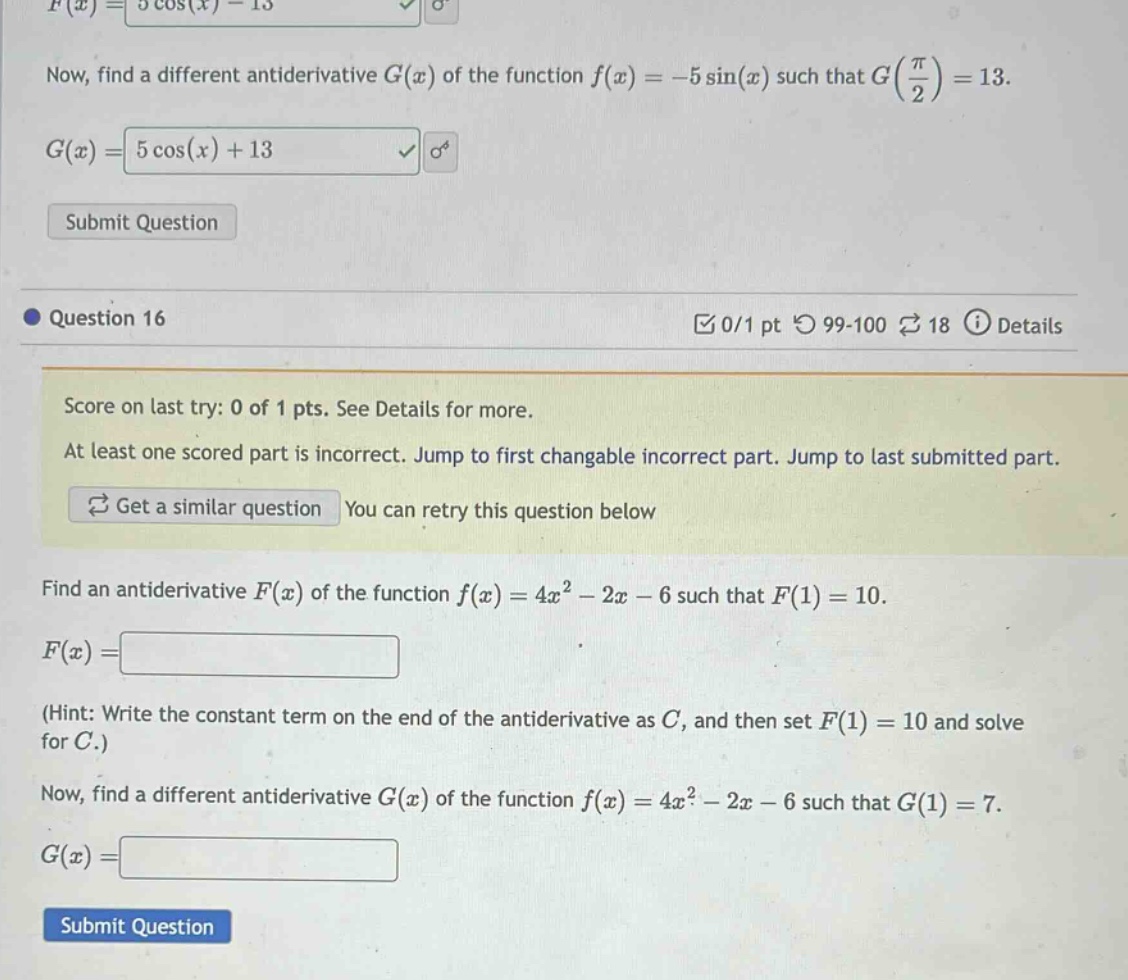
now, find a different antiderivative g(x) of the function f(x)=−5sin(x) such that g(π/2)=13. g(x)=5cos(x)+13 submit question question 16 0/1 pt 99 - 100 18 details score on last try: 0 of 1 pts. see details for more. at least one scored part is incorrect. jump to first changeable incorrect part. jump to last submitted part. get a similar question you can retry this question below find an antiderivative f(x) of the function f(x)=4x²−2x−6 such that f(1)=10. f(x)= (hint: write the constant term on the end of the antiderivative as c, and then set f(1)=10 and solve for c.) now, find a different antiderivative g(x) of the function f(x)=4x²−2x−6 such that g(1)=7. g(x)=
Answer
Explanation:
Step1: Find the general antiderivative of $f(x)=4x^{2}-2x - 6$
The antiderivative of $x^n$ is $\frac{x^{n + 1}}{n+1}+C$ ($n\neq - 1$). So, $F(x)=\int(4x^{2}-2x - 6)dx=4\times\frac{x^{3}}{3}-2\times\frac{x^{2}}{2}-6x + C=\frac{4}{3}x^{3}-x^{2}-6x + C$.
Step2: Solve for $C$ using $F(1) = 10$
Substitute $x = 1$ into $F(x)$: $F(1)=\frac{4}{3}(1)^{3}-(1)^{2}-6(1)+C$. Then $10=\frac{4}{3}-1 - 6+C$. Simplify the right - hand side: $\frac{4}{3}-1 - 6=\frac{4 - 3-18}{3}=-\frac{17}{3}$. So, $10=-\frac{17}{3}+C$, and $C = 10+\frac{17}{3}=\frac{30 + 17}{3}=\frac{47}{3}$. Thus, $F(x)=\frac{4}{3}x^{3}-x^{2}-6x+\frac{47}{3}$.
Step3: Find the general antiderivative of $f(x)=4x^{2}-2x - 6$ for $G(x)$
$G(x)=\frac{4}{3}x^{3}-x^{2}-6x + D$ (using a different constant $D$).
Step4: Solve for $D$ using $G(1)=7$
Substitute $x = 1$ into $G(x)$: $G(1)=\frac{4}{3}(1)^{3}-(1)^{2}-6(1)+D$. Then $7=\frac{4}{3}-1 - 6+D$. Simplify the right - hand side: $\frac{4}{3}-1 - 6=-\frac{17}{3}$. So, $7=-\frac{17}{3}+D$, and $D=7+\frac{17}{3}=\frac{21 + 17}{3}=\frac{38}{3}$. Thus, $G(x)=\frac{4}{3}x^{3}-x^{2}-6x+\frac{38}{3}$.
Answer:
$F(x)=\frac{4}{3}x^{3}-x^{2}-6x+\frac{47}{3}$ $G(x)=\frac{4}{3}x^{3}-x^{2}-6x+\frac{38}{3}$