now we integrate term by term. ∫e^(-4x²) dx = ∫(1 - 4x²/1! + 16x⁴/2! - 64x⁶/3! +... + (-1)^n 4^n x^(2n)/n!)…
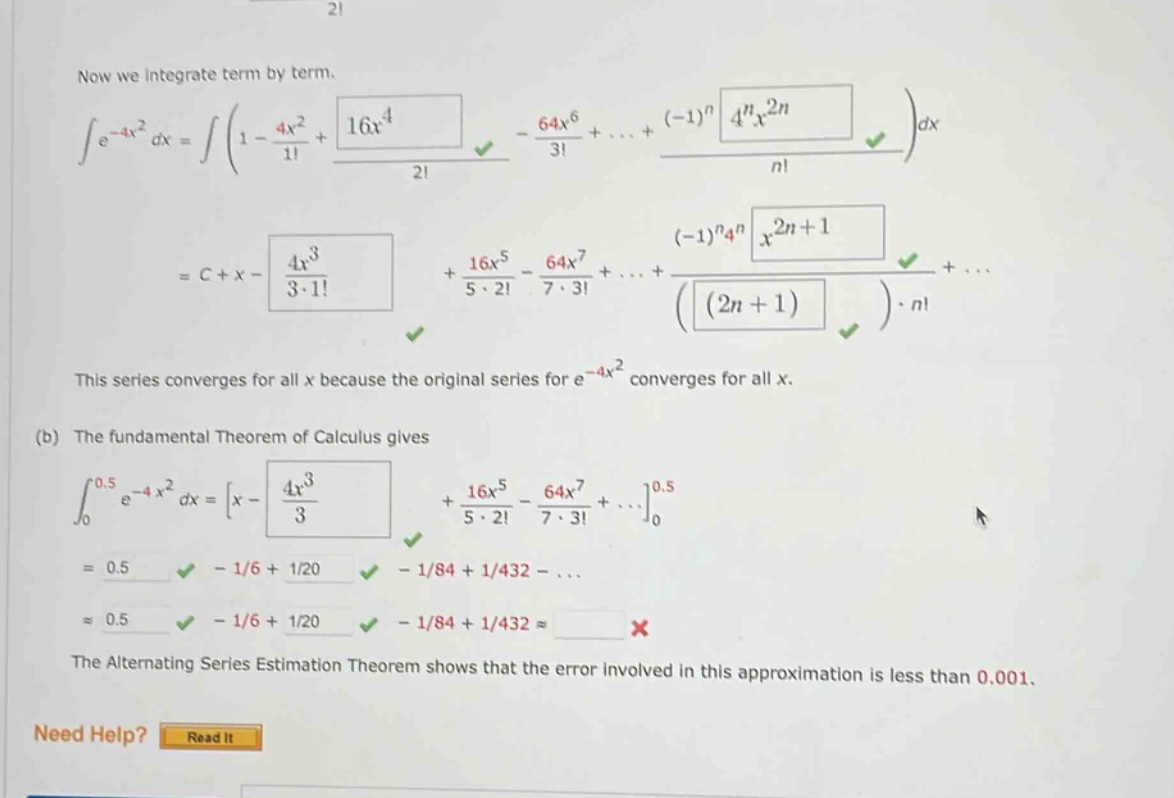
now we integrate term by term. ∫e^(-4x²) dx = ∫(1 - 4x²/1! + 16x⁴/2! - 64x⁶/3! +... + (-1)^n 4^n x^(2n)/n!) dx = c + x - 4x³/(3·1!) + 16x⁵/(5·2!) - 64x⁷/(7·3!) +... + (-1)^n 4^n x^(2n + 1)/((2n + 1)·n!) +... this series converges for all x because the original series for e^(-4x²) converges for all x. (b) the fundamental theorem of calculus gives ∫₀⁰.⁵ e^(-4x²) dx = x - 4x³/3 + 16x⁵/(5·2!) - 64x⁷/(7·3!) +...₀⁰.⁵ = 0.5 - 1/6 + 1/20 - 1/84 + 1/432 -... ≈ 0.5 - 1/6 + 1/20 - 1/84 + 1/432 ≈ the alternating series estimation theorem shows that the error involved in this approximation is less than 0.001. need help? read it
Answer
Explanation:
Step1: Recall power - series expansion of (e^u)
The power - series expansion of (e^u=\sum_{n = 0}^{\infty}\frac{u^n}{n!}=1 + u+\frac{u^2}{2!}+\frac{u^3}{3!}+\cdots). Let (u=-4x^{2}), then (e^{-4x^{2}}=\sum_{n = 0}^{\infty}\frac{(-4x^{2})^{n}}{n!}=1-\frac{4x^{2}}{1!}+\frac{16x^{4}}{2!}-\frac{64x^{6}}{3!}+\cdots+(-1)^{n}\frac{4^{n}x^{2n}}{n!}).
Step2: Integrate term - by - term
(\int e^{-4x^{2}}dx=\int\left(1-\frac{4x^{2}}{1!}+\frac{16x^{4}}{2!}-\frac{64x^{6}}{3!}+\cdots+(-1)^{n}\frac{4^{n}x^{2n}}{n!}\right)dx). Using the power - rule for integration (\int x^{m}dx=\frac{x^{m + 1}}{m+1}+C) ((m\neq - 1)), we get (\int e^{-4x^{2}}dx=C + x-\frac{4x^{3}}{3\cdot1!}+\frac{16x^{5}}{5\cdot2!}-\frac{64x^{7}}{7\cdot3!}+\cdots+\frac{(-1)^{n}4^{n}x^{2n + 1}}{(2n+1)\cdot n!}+\cdots).
Step3: Evaluate the definite integral
By the fundamental theorem of calculus, (\int_{0}^{0.5}e^{-4x^{2}}dx=\left[x-\frac{4x^{3}}{3}+\frac{16x^{5}}{5\cdot2!}-\frac{64x^{7}}{7\cdot3!}+\cdots\right]_{0}^{0.5}). Substitute (x = 0.5) and (x = 0) into the antiderivative: When (x = 0.5), we have (0.5-\frac{4\times(0.5)^{3}}{3}+\frac{16\times(0.5)^{5}}{5\times2!}-\frac{64\times(0.5)^{7}}{7\times3!}+\cdots). (0.5-\frac{4\times\frac{1}{8}}{3}+\frac{16\times\frac{1}{32}}{10}-\frac{64\times\frac{1}{128}}{42}+\cdots=0.5-\frac{1}{6}+\frac{1}{20}-\frac{1}{84}+\cdots).
Step4: Approximate the sum
(0.5-\frac{1}{6}+\frac{1}{20}-\frac{1}{84}+\frac{1}{432}) (0.5 - 0.1667+0.05 - 0.0119+0.0023) (=0.3737)
Answer:
(0.3737)