the number of hours of daylight in a town changes at a rate of 1/20 cos(t/60 + 2) hours per day (where t is…
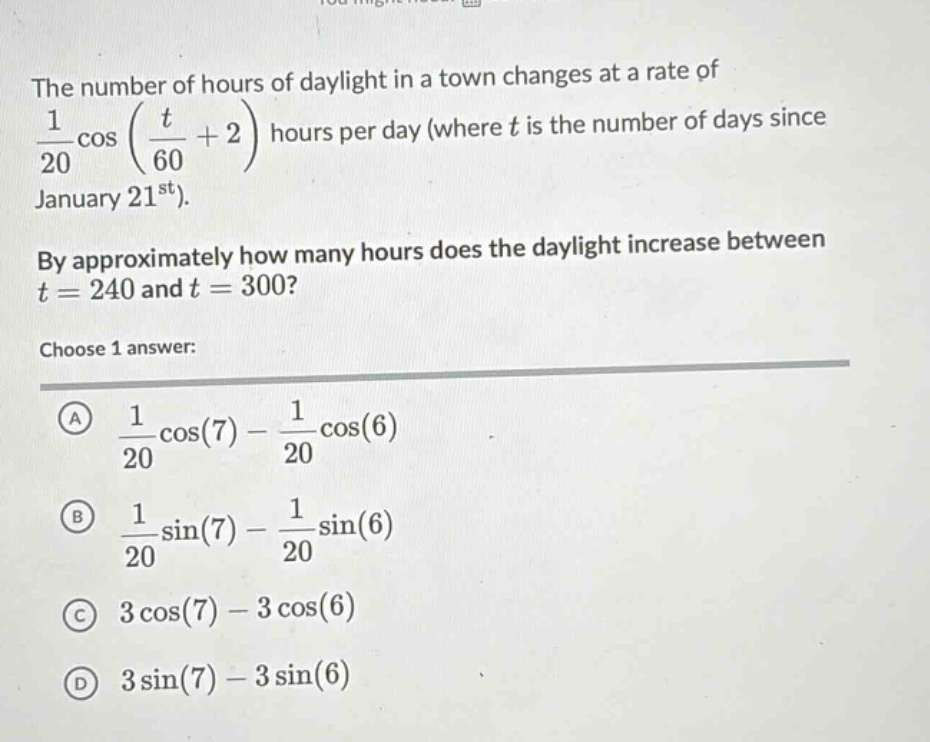
the number of hours of daylight in a town changes at a rate of 1/20 cos(t/60 + 2) hours per day (where t is the number of days since january 21st). by approximately how many hours does the daylight increase between t = 240 and t = 300? choose 1 answer: a 1/20 cos(7) - 1/20 cos(6) b 1/20 sin(7) - 1/20 sin(6) c 3 cos(7) - 3 cos(6) d 3 sin(7) - 3 sin(6)
Answer
Explanation:
Step1: Recall the definite - integral formula
The change in a quantity $y$ over an interval $[a,b]$ given its rate of change $y^\prime(t)$ is $\int_{a}^{b}y^\prime(t)dt$. Here, $y^\prime(t)=\frac{1}{20}\cos(\frac{t}{60}+2)$, $a = 240$, and $b = 300$.
Step2: Perform substitution
Let $u=\frac{t}{60}+2$, then $du=\frac{1}{60}dt$. When $t = 240$, $u=\frac{240}{60}+2=4 + 2=6$. When $t = 300$, $u=\frac{300}{60}+2=5 + 2=7$. And $dt = 60du$. So, $\int_{240}^{300}\frac{1}{20}\cos(\frac{t}{60}+2)dt=\int_{6}^{7}\frac{1}{20}\cos(u)\times60du$.
Step3: Simplify the integral
$\int_{6}^{7}\frac{1}{20}\cos(u)\times60du=\int_{6}^{7}3\cos(u)du$.
Step4: Integrate $\cos(u)$
The antiderivative of $\cos(u)$ is $\sin(u)$. Using the fundamental theorem of calculus $\int_{6}^{7}3\cos(u)du=3[\sin(u)]_{6}^{7}=3\sin(7)-3\sin(6)$.
Answer:
D. $3\sin(7)-3\sin(6)$