the number of moose in a national park is modeled by the function m that satisfies the logistic differential…
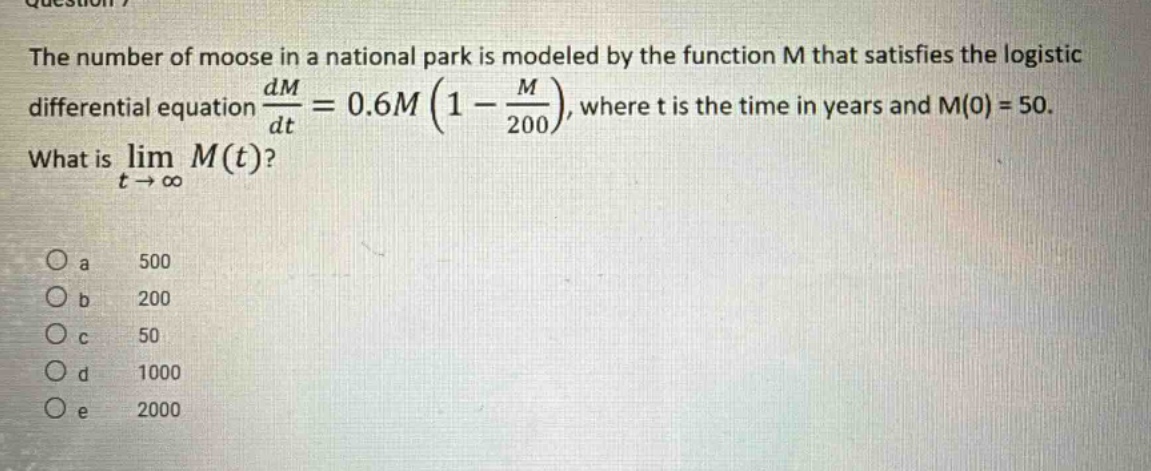
the number of moose in a national park is modeled by the function m that satisfies the logistic differential equation dm/dt = 0.6m(1 - m/200), where t is the time in years and m(0) = 50. what is lim m(t) as t -> ∞? o a 500 o b 200 o c 50 o d 1000 o e 2000
Answer
Explanation:
Step1: Recall logistic - equation form
The logistic differential equation is $\frac{dM}{dt}=kM(1 - \frac{M}{L})$, where $L$ is the carrying capacity.
Step2: Identify the carrying capacity
Comparing $\frac{dM}{dt}=0.6M(1 - \frac{M}{200})$ with $\frac{dM}{dt}=kM(1 - \frac{M}{L})$, we can see that $L = 200$.
Step3: Use the property of logistic - growth
For a logistic - growth model $\frac{dM}{dt}=kM(1 - \frac{M}{L})$, $\lim_{t\rightarrow\infty}M(t)=L$.
Answer:
B. 200