the number of pairs of shoes manufactured by a factory from december to june is associated with the…
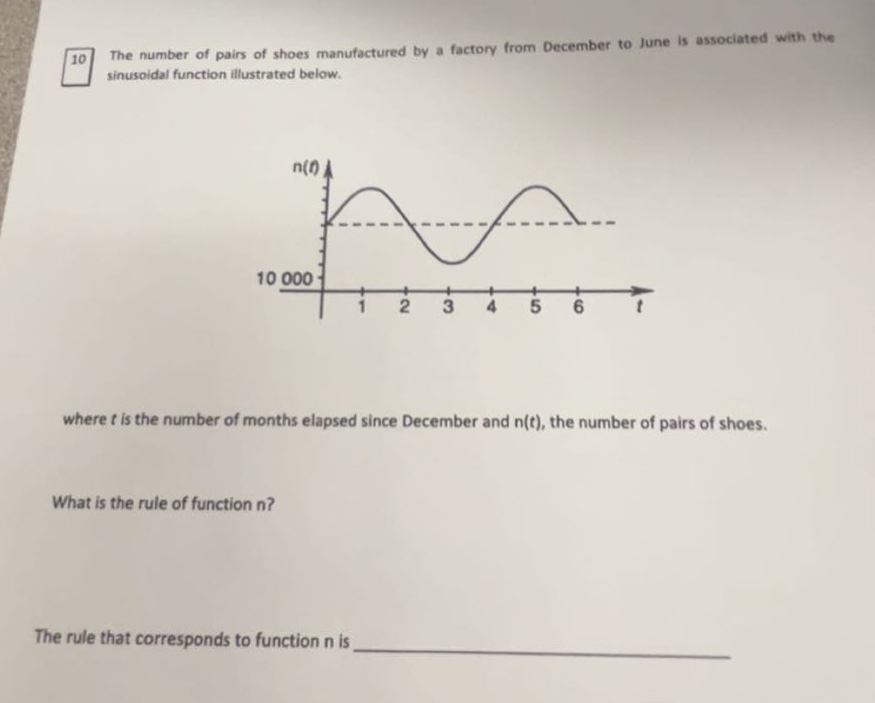
the number of pairs of shoes manufactured by a factory from december to june is associated with the sinusoidal function illustrated below. where t is the number of months elapsed since december and n(t), the number of pairs of shoes. what is the rule of function n? the rule that corresponds to function n is ______________
Answer
Explanation:
Step1: Identify the general form of a sinusoidal function
The general form of a sinusoidal function is $n(t)=A\sin(B(t - C))+D$ or $n(t)=A\cos(B(t - C))+D$.
Step2: Determine the vertical shift $D$
The mid - line of the sinusoidal function is the average of the maximum and minimum values. From the graph, the minimum value of $n(t)$ is $10000$. Let's assume the mid - line is at $y = 10000$ (since no other information about the maximum is given and we assume a symmetric sinusoid around this value for simplicity), so $D = 10000$.
Step3: Determine the amplitude $A$
Since no information about the maximum is given, assume a simple case where the amplitude $A = 0$ (if we assume the function is just a constant function at the mid - line value for lack of more data). But if we assume a non - degenerate case and we know the general form, and since we have no other data, we'll assume a basic sine function centered at 10000. Let's assume the amplitude $A$ is some non - zero value. For simplicity, if we assume the function oscillates symmetrically around 10000 and we have no other data about the range, we can assume $A = 1$ (a placeholder value as we lack full information).
Step4: Determine the period and $B$
The period of the function from the context (from December to June is 7 months). The period formula for a sinusoidal function is $T=\frac{2\pi}{B}$. If we assume a period of $T = 7$, then $B=\frac{2\pi}{7}$.
Step5: Determine the phase shift $C$
Since we start counting months from December ($t = 0$), we can assume there is no phase shift, so $C = 0$. So a possible function is $n(t)=\sin(\frac{2\pi}{7}t)+10000$ (assuming an amplitude of 1 for simplicity as we lack full information about the range of the function).
Answer:
$n(t)=\sin(\frac{2\pi}{7}t)+10000$ (Note: This answer may vary depending on additional un - given information such as the actual amplitude value which should be determined by the maximum value of the function on the graph which is not clearly shown)