of all numbers x and y whose sum is 50, the two that have the maximum product are x = 25 and y = 25. that…
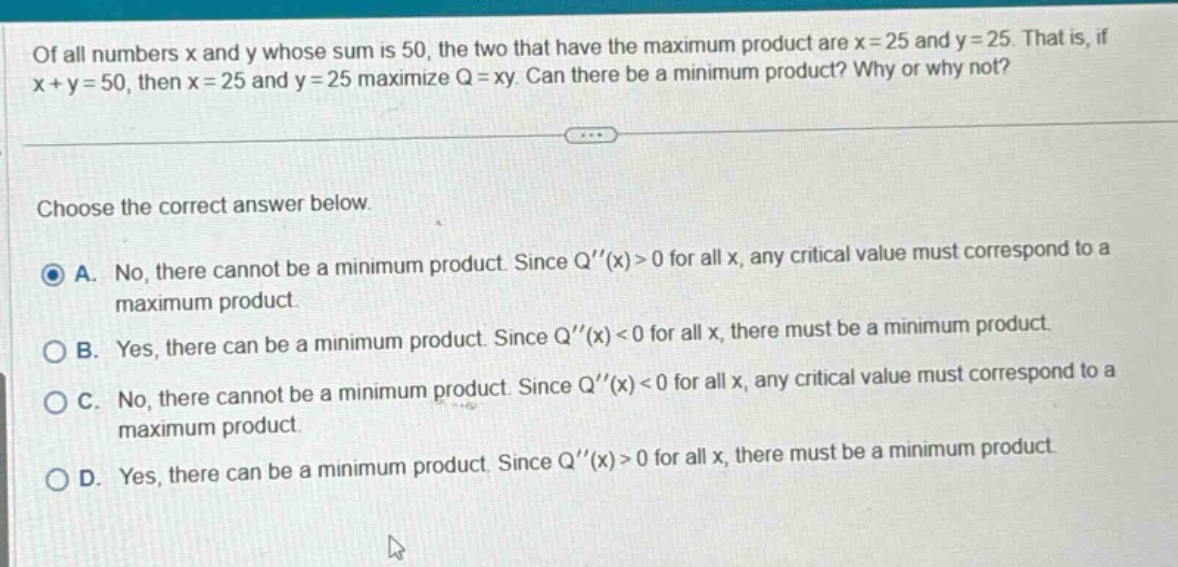
of all numbers x and y whose sum is 50, the two that have the maximum product are x = 25 and y = 25. that is, if x + y = 50, then x = 25 and y = 25 maximize q = xy. can there be a minimum product? why or why not? choose the correct answer below. a. no, there cannot be a minimum product. since q(x)>0 for all x, any critical value must correspond to a maximum product. b. yes, there can be a minimum product. since q(x)<0 for all x, there must be a minimum product. c. no, there cannot be a minimum product. since q(x)<0 for all x, any critical value must correspond to a maximum product. d. yes, there can be a minimum product. since q(x)>0 for all x, there must be a minimum product.
Answer
Explanation:
Step1: Express y in terms of x
Given (x + y=50), then (y = 50 - x). So (Q(x)=x(50 - x)=50x - x^{2}).
Step2: Find the first - derivative
Differentiate (Q(x)) with respect to (x). (Q'(x)=\frac{d}{dx}(50x - x^{2})=50 - 2x).
Step3: Find the critical points
Set (Q'(x) = 0), so (50-2x = 0), which gives (x = 25).
Step4: Find the second - derivative
Differentiate (Q'(x)) with respect to (x). (Q''(x)=\frac{d}{dx}(50 - 2x)=- 2<0) for all (x). When the second - derivative (Q''(x)<0) at a critical point, the function has a maximum at that point. Since there are no restrictions on (x) and (y) (they are just real numbers such that (x + y = 50)), there is no minimum product.
Answer:
C. No, there cannot be a minimum product. Since (Q''(x)<0) for all (x), any critical value must correspond to a maximum product.