numerically estimate the value of the following limit, making sure your final answer is accurate to one…
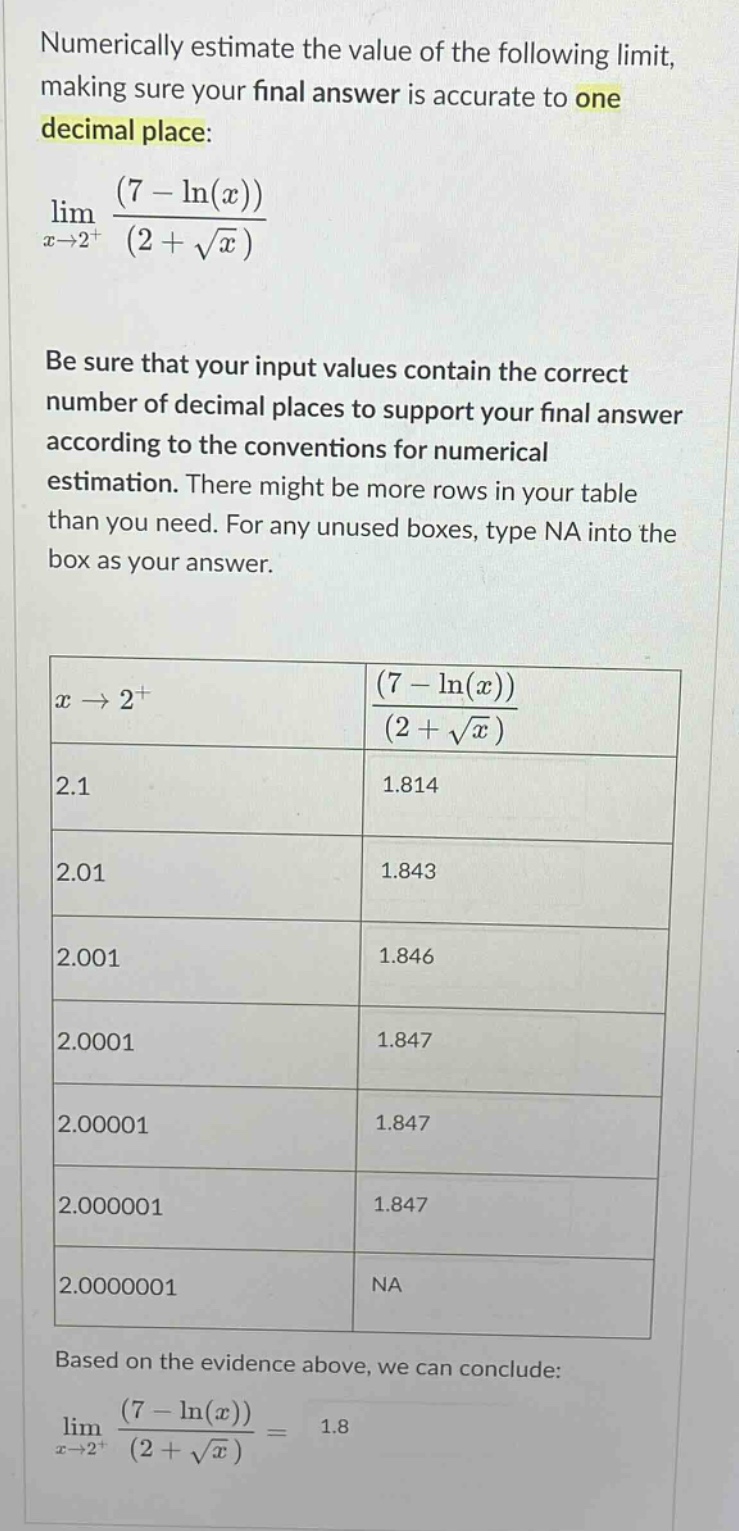
numerically estimate the value of the following limit, making sure your final answer is accurate to one decimal place: lim(x→2⁺) (7 - ln(x))/(2 + √x) be sure that your input values contain the correct number of decimal places to support your final answer according to the conventions for numerical estimation. there might be more rows in your table than you need. for any unused boxes, type na into the box as your answer. x → 2⁺ (7 - ln(x))/(2 + √x) 2.1 1.814 2.01 1.843 2.001 1.846 2.0001 1.847 2.00001 1.847 2.000001 1.847 2.0000001 na based on the evidence above, we can conclude: lim(x→2⁺) (7 - ln(x))/(2 + √x) = 1.8
Answer
Explanation:
Step1: Analyze the table values
As $x$ approaches $2$ from the right ($x\to2^{+}$), we observe the values of $\frac{7 - \ln(x)}{2+\sqrt{x}}$.
Step2: Determine the limit value
The values in the table converge to $1.847$ and when rounded to one - decimal place, we get the limit value.
Answer:
$1.8$