an object is propelled upward at an angle θ, 45° < θ < 90°, to the horizontal with an initial velocity of v0…
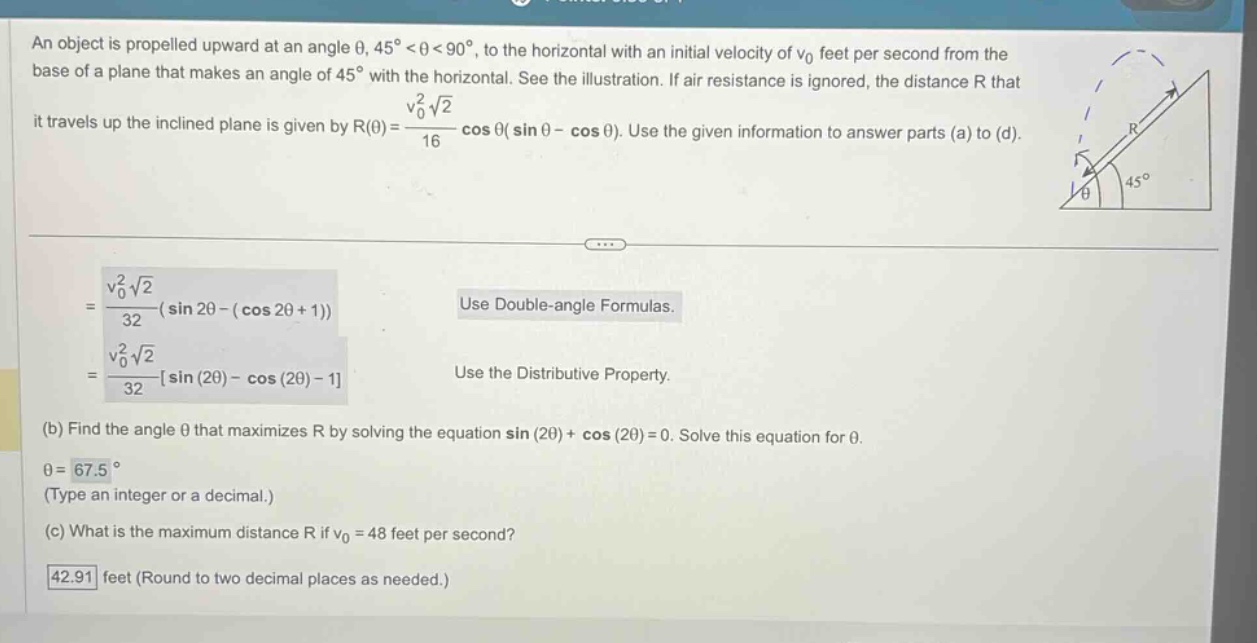
an object is propelled upward at an angle θ, 45° < θ < 90°, to the horizontal with an initial velocity of v0 feet per second from the base of a plane that makes an angle of 45° with the horizontal. see the illustration. if air resistance is ignored, the distance r that it travels up the inclined plane is given by r(θ) = (v0²√2 / 16) cos θ(sin θ - cos θ). use the given information to answer parts (a) to (d). = (v0²√2 / 32) (sin 2θ - (cos 2θ + 1)) use double - angle formulas. = (v0²√2 / 32) sin (2θ) - cos (2θ) - 1 use the distributive property. (b) find the angle θ that maximizes r by solving the equation sin (2θ) + cos (2θ) = 0. solve this equation for θ. θ = 67.5 ° (type an integer or a decimal.) (c) what is the maximum distance r if v0 = 48 feet per second? 42.91 feet (round to two decimal places as needed.)
Answer
Explanation:
Step1: Recall the formula for R
We are given $R(\theta)=\frac{v_{0}^{2}\sqrt{2}}{16}\cos\theta(\sin\theta - \cos\theta)$.
Step2: Substitute $v_{0}=48$ into the formula
First, substitute $v_{0} = 48$ into the formula. So $v_{0}^{2}=48^{2}=2304$. Then the formula for $R$ becomes $R(\theta)=\frac{2304\sqrt{2}}{16}\cos\theta(\sin\theta - \cos\theta)=144\sqrt{2}\cos\theta(\sin\theta - \cos\theta)$. We know from part (b) that the maximum occurs at $\theta = 67.5^{\circ}$. $\cos(67.5^{\circ})=\frac{\sqrt{2-\sqrt{2}}}{2}$ and $\sin(67.5^{\circ})=\frac{\sqrt{2 + \sqrt{2}}}{2}$ $R=\frac{v_{0}^{2}\sqrt{2}}{32}[\sin(2\theta)-\cos(2\theta)-1]$. Substitute $\theta = 67.5^{\circ}$, then $2\theta=135^{\circ}$, $\sin(135^{\circ})=\frac{\sqrt{2}}{2}$, $\cos(135^{\circ})=-\frac{\sqrt{2}}{2}$ $R=\frac{48^{2}\sqrt{2}}{32}[\frac{\sqrt{2}}{2}-(-\frac{\sqrt{2}}{2})-1]=\frac{2304\sqrt{2}}{32}(\sqrt{2}-1)$ $=\frac{2304\times2 - 2304\sqrt{2}}{32}=\frac{4608-2304\sqrt{2}}{32}=144 - 72\sqrt{2}\approx42.91$
Answer:
$42.91$