an object is propelled upward at an angle θ, 45° < θ < 90°, to the horizontal with an initial velocity of v0…
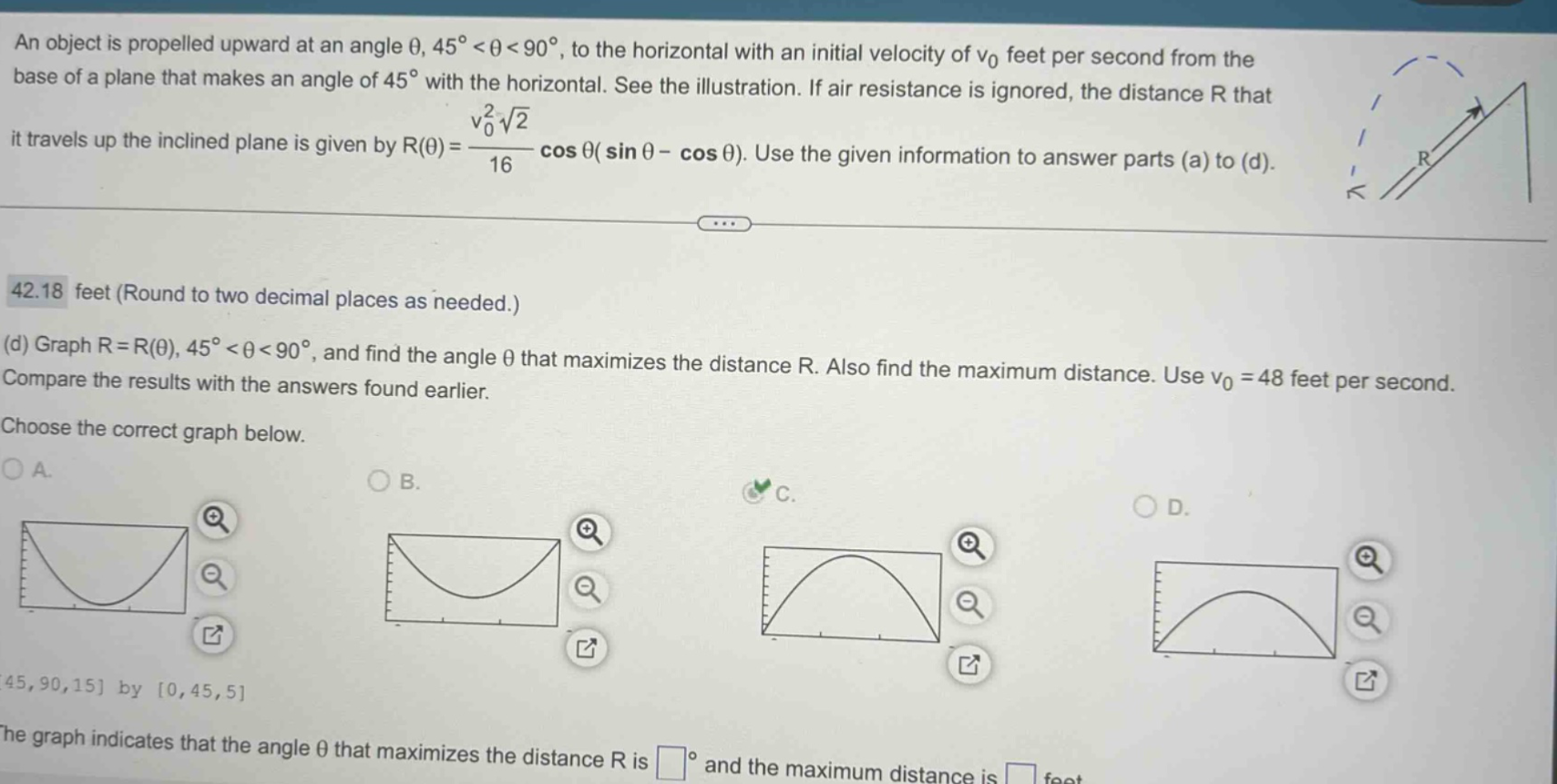
an object is propelled upward at an angle θ, 45° < θ < 90°, to the horizontal with an initial velocity of v0 feet per second from the base of a plane that makes an angle of 45° with the horizontal. see the illustration. if air resistance is ignored, the distance r that it travels up the inclined plane is given by r(θ)=v0²√2/16 cos θ(sin θ - cos θ). use the given information to answer parts (a) to (d). 42.18 feet (round to two decimal places as needed.) (d) graph r = r(θ), 45° < θ < 90°, and find the angle θ that maximizes the distance r. also find the maximum distance. use v0 = 48 feet per second. compare the results with the answers found earlier. choose the correct graph below. a. b. c. d. 45,90,15 by 0,45,5 the graph indicates that the angle θ that maximizes the distance r is ° and the maximum distance is feet
Answer
Explanation:
Step1: Substitute (v_0 = 48) into the formula
Given (R(\theta)=\frac{v_0^{2}\sqrt{2}}{16}\cos\theta(\sin\theta - \cos\theta)), substituting (v_0 = 48) gives (R(\theta)=\frac{48^{2}\sqrt{2}}{16}\cos\theta(\sin\theta - \cos\theta)=144\sqrt{2}\cos\theta(\sin\theta - \cos\theta))
Step2: Expand the function
[ \begin{align*} R(\theta)&=144\sqrt{2}(\cos\theta\sin\theta-\cos^{2}\theta)\ &=144\sqrt{2}(\frac{1}{2}\sin2\theta-\frac{1 + \cos2\theta}{2})\ &=72\sqrt{2}(\sin2\theta-(1 + \cos2\theta))\ &=72\sqrt{2}(\sin2\theta-\cos2\theta - 1) \end{align*} ]
Step3: Rewrite using the auxiliary - angle formula
We know that (a\sin x+b\cos x=\sqrt{a^{2}+b^{2}}\sin(x +\varphi)), where (a = 1), (b=- 1), so (\sin2\theta-\cos2\theta=\sqrt{1^{2}+(-1)^{2}}\sin(2\theta-\frac{\pi}{4})=\sqrt{2}\sin(2\theta-\frac{\pi}{4}))
Then (R(\theta)=72\sqrt{2}(\sqrt{2}\sin(2\theta-\frac{\pi}{4})-1)=144\sin(2\theta-\frac{\pi}{4})-72)
Step4: Find the maximum of the function
Since (45^{\circ}<\theta<90^{\circ}), then (90^{\circ}<2\theta<180^{\circ}) and (45^{\circ}<2\theta-\frac{\pi}{4}<135^{\circ})
The maximum value of (y = \sin(2\theta-\frac{\pi}{4})) in the interval ((45^{\circ},135^{\circ})) occurs when (2\theta-\frac{\pi}{4}=90^{\circ}), i.e., (2\theta=90^{\circ}+\frac{\pi}{4}=135^{\circ}), so (\theta = 67.5^{\circ})
Step5: Calculate the maximum distance
Substitute (\theta = 67.5^{\circ}) into (R(\theta))
[ \begin{align*} R(67.5^{\circ})&=144\sin(90^{\circ})-72\ &=144 - 72\ &=72 \end{align*} ]
Answer:
The angle (\theta) that maximizes the distance (R) is (67.5^{\circ}) and the maximum distance is (72) feet.