8. objective: graph exponential functions a^x with different positive values of a corresponding textbook…
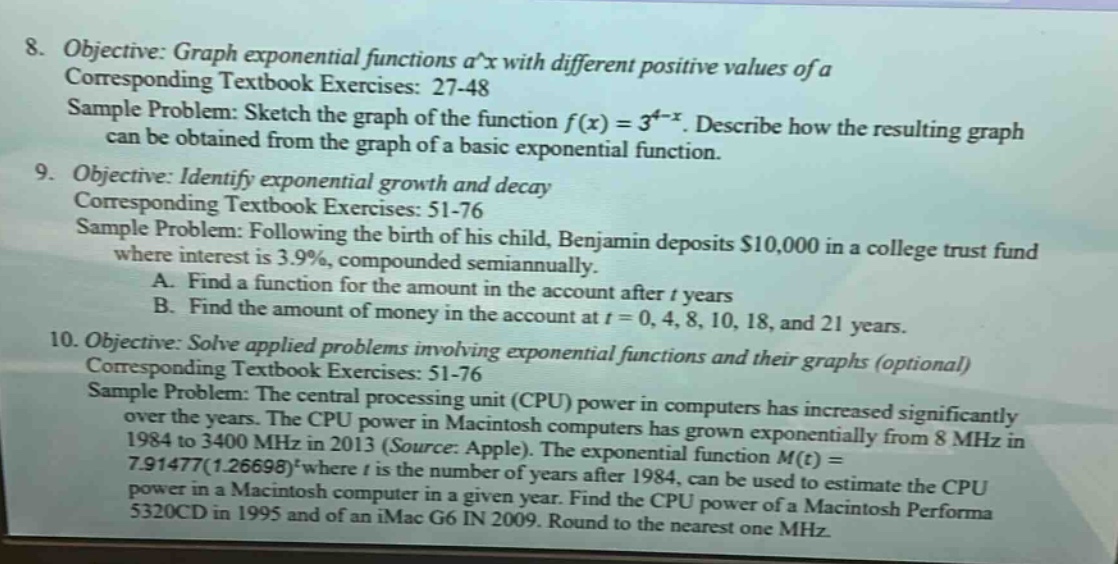
8. objective: graph exponential functions a^x with different positive values of a corresponding textbook exercises: 27 - 48 sample problem: sketch the graph of the function f(x)=3^(4 - x). describe how the resulting graph can be obtained from the graph of a basic exponential function. 9. objective: identify exponential growth and decay corresponding textbook exercises: 51 - 76 sample problem: following the birth of his child, benjamin deposits $10,000 in a college trust fund where interest is 3.9%, compounded semiannually. a. find a function for the amount in the account after t years b. find the amount of money in the account at t = 0, 4, 8, 10, 18, and 21 years. 10. objective: solve applied problems involving exponential functions and their graphs (optional) corresponding textbook exercises: 51 - 76 sample problem: the central processing unit (cpu) power in computers has increased significantly over the years. the cpu power in macintosh computers has grown exponentially from 8 mhz in 1984 to 3400 mhz in 2013 (source: apple). the exponential function m(t)=7.91477(1.26698)^t where t is the number of years after 1984, can be used to estimate the cpu power in a macintosh computer in a given year. find the cpu power of a macintosh performa 5320cd in 1995 and of an imac g6 in 2009. round to the nearest one mhz.
Answer
8.
Explanation:
Step1: Recall basic exponential - function form
The basic exponential function is (y = a^{x}). For (y = 3^{4 - x}=3^{-(x - 4)}), we can use transformation rules.
Step2: Identify transformations
The graph of (y = 3^{4 - x}) can be obtained from the graph of (y = 3^{x}) by first reflecting it about the (y) - axis (due to the negative sign in the exponent (-x)) and then shifting it 4 units to the right (because of (x-4)). To sketch the graph, we can find some key points. When (x = 4), (y=3^{4 - 4}=1). As (x\rightarrow-\infty), (y\rightarrow\infty) and as (x\rightarrow\infty), (y\rightarrow0).
9.
Explanation:
Step1: Use compound - interest formula
The compound - interest formula is (A(t)=P(1 +\frac{r}{n})^{nt}), where (P) is the principal amount, (r) is the annual interest rate (in decimal form), (n) is the number of times compounded per year, and (t) is the number of years. Here, (P = 10000), (r=0.039), and (n = 2). So the function for the amount in the account after (t) years is (A(t)=10000(1+\frac{0.039}{2})^{2t}=10000(1.0195)^{2t}).
Step2: Calculate amounts for different (t) values
- When (t = 0): (A(0)=10000(1.0195)^{2\times0}=10000)
- When (t = 4): (A(4)=10000(1.0195)^{2\times4}=10000(1.0195)^{8}\approx11676.52)
- When (t = 8): (A(8)=10000(1.0195)^{2\times8}=10000(1.0195)^{16}\approx13630.72)
- When (t = 10): (A(10)=10000(1.0195)^{2\times10}=10000(1.0195)^{20}\approx14774.55)
- When (t = 18): (A(18)=10000(1.0195)^{2\times18}=10000(1.0195)^{36}\approx20798.93)
- When (t = 21): (A(21)=10000(1.0195)^{2\times21}=10000(1.0195)^{42}\approx23478.97)
10.
Explanation:
Step1: Determine (t) values
For the Macintosh Performa 5320CD in 1995, (t=1995 - 1984 = 11). For the iMac G6 in 2009, (t=2009 - 1984 = 25).
Step2: Calculate CPU power
- For (t = 11): (M(11)=7.91477(1.26698)^{11}\approx7.91477\times11.977\approx94) MHz
- For (t = 25): (M(25)=7.91477(1.26698)^{25}\approx7.91477\times138.97\approx1099) MHz
Answer:
For problem 8: The graph of (y = 3^{4 - x}) is obtained by reflecting (y = 3^{x}) about the (y) - axis and shifting 4 units to the right. For problem 9: A. (A(t)=10000(1.0195)^{2t}); B. (A(0) = 10000), (A(4)\approx11676.52), (A(8)\approx13630.72), (A(10)\approx14774.55), (A(18)\approx20798.93), (A(21)\approx23478.97) For problem 10: CPU power of Macintosh Performa 5320CD in 1995 is about 94 MHz and of iMac G6 in 2009 is about 1099 MHz.