if an objects position over time is given by the function d(t)=(t² + 3)e^(-t/2) for t > 0, on what interval…
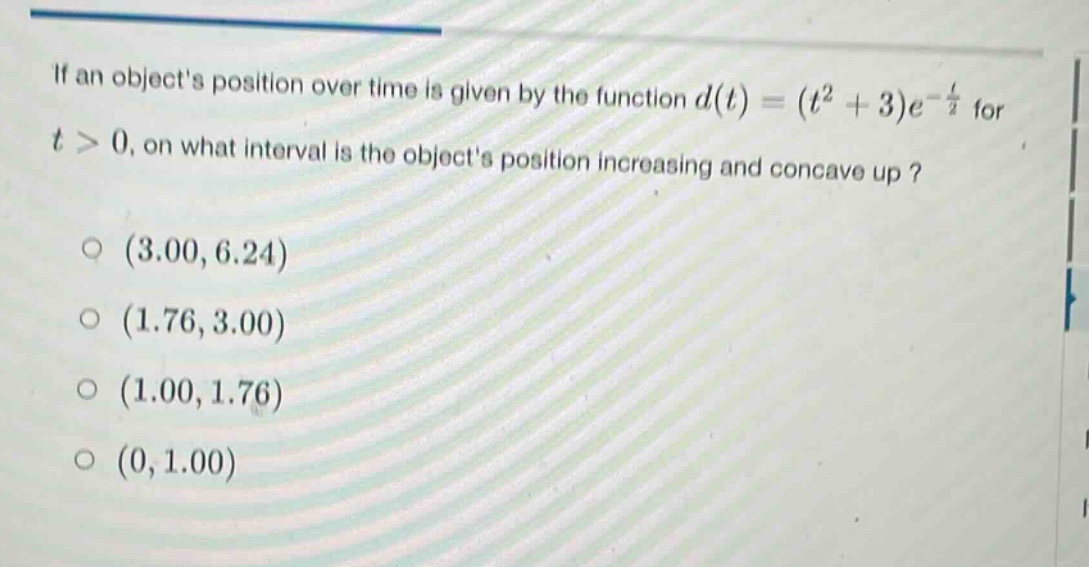
if an objects position over time is given by the function d(t)=(t² + 3)e^(-t/2) for t > 0, on what interval is the objects position increasing and concave up? (3.00,6.24) (1.76,3.00) (1.00,1.76) (0,1.00)
Answer
Explanation:
Step1: Find the first - derivative
Use the product rule $(uv)' = u'v+uv'$, where $u=t^{2}+3$ and $v = e^{-\frac{t}{2}}$. $u' = 2t$ and $v'=-\frac{1}{2}e^{-\frac{t}{2}}$. $d'(t)=2te^{-\frac{t}{2}}-(t^{2}+3)\frac{1}{2}e^{-\frac{t}{2}}=e^{-\frac{t}{2}}(2t-\frac{t^{2}+3}{2})=\frac{e^{-\frac{t}{2}}(-t^{2} + 4t-3)}{2}$. Set $d'(t)>0$ to find where the function is increasing. $e^{-\frac{t}{2}}>0$ for all $t$, so we solve $-t^{2}+4t - 3>0$. $t^{2}-4t + 3<0$, factoring gives $(t - 1)(t - 3)<0$. The solution is $1<t<3$.
Step2: Find the second - derivative
Use the quotient rule on $d'(t)=\frac{-t^{2}+4t - 3}{2e^{\frac{t}{2}}}$. The quotient rule is $(\frac{u}{v})'=\frac{u'v - uv'}{v^{2}}$, where $u=-t^{2}+4t - 3$, $u'=-2t + 4$, $v = 2e^{\frac{t}{2}}$, $v'=e^{\frac{t}{2}}$. $d''(t)=\frac{(-2t + 4)\times2e^{\frac{t}{2}}-(-t^{2}+4t - 3)\times e^{\frac{t}{2}}}{4e^{t}}=\frac{e^{\frac{t}{2}}(-4t + 8+t^{2}-4t + 3)}{4e^{t}}=\frac{t^{2}-8t + 11}{4e^{\frac{t}{2}}}$. Set $d''(t)>0$ to find where the function is concave up. We solve $t^{2}-8t + 11>0$. Using the quadratic formula $t=\frac{8\pm\sqrt{64 - 44}}{2}=\frac{8\pm\sqrt{20}}{2}=4\pm\sqrt{5}$. The solutions of $t^{2}-8t + 11 = 0$ are $t_1=4-\sqrt{5}\approx1.76$ and $t_2=4+\sqrt{5}\approx6.24$. The inequality $t^{2}-8t + 11>0$ gives $t<4 - \sqrt{5}$ or $t>4+\sqrt{5}$.
Step3: Find the intersection
We want the intersection of the intervals where $d'(t)>0$ ($1<t<3$) and $d''(t)>0$ ($t<4 - \sqrt{5}$ or $t>4+\sqrt{5}$). The intersection is $1.76<t<3$.
Answer:
$(1.76,3.00)$