an observer stands 24 m from the bottom of a ferris wheel on a line that is perpendicular to the face of the…
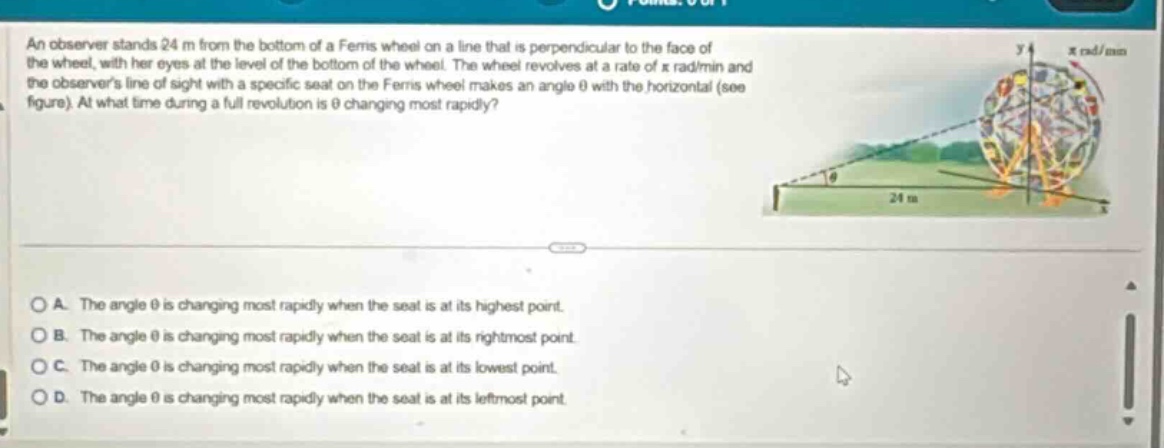
an observer stands 24 m from the bottom of a ferris wheel on a line that is perpendicular to the face of the wheel, with her eyes at the level of the bottom of the wheel. the wheel revolves at a rate of x rad/min and the observers line of sight with a specific seat on the ferris wheel makes an angle θ with the horizontal (see figure). at what time during a full revolution is θ changing most rapidly?\n\na. the angle θ is changing most rapidly when the seat is at its highest point.\nb. the angle θ is changing most rapidly when the seat is at its rightmost point.\nc. the angle θ is changing most rapidly when the seat is at its lowest point.\nd. the angle θ is changing most rapidly when the seat is at its leftmost point.
Answer
Explanation:
Step1: Establish a trigonometric relation
Let the radius of the Ferris - wheel be (r). We can use the tangent function. (\tan\theta=\frac{y}{24}), where (y) is the vertical distance of the seat from the horizontal line passing through the observer's eyes. As the Ferris - wheel rotates, if the angular speed is (\omega=\pi) rad/min, and the position of the seat is given by (y = r\sin\omega t) (assuming the center of the Ferris - wheel is at the origin of a coordinate system with the observer on the (x) - axis at (x=-24)). Then (\tan\theta=\frac{r\sin\omega t}{24}). Differentiating both sides with respect to time (t) using the chain - rule: (\sec^{2}\theta\frac{d\theta}{dt}=\frac{r\omega\cos\omega t}{24}), so (\frac{d\theta}{dt}=\frac{r\omega\cos\omega t}{24\sec^{2}\theta}).
Step2: Analyze the maximum of (\frac{d\theta}{dt})
We know that (\sec^{2}\theta = 1+\tan^{2}\theta). When the seat is at the rightmost point, (\theta) changes most rapidly. Geometrically, when the seat is at the rightmost point of the Ferris - wheel, the rate of change of the line of sight with respect to the rotation of the wheel is the greatest. At the rightmost point, the component of the linear velocity of the seat that affects the change in the angle (\theta) is maximized.
Answer:
B. The angle θ is changing most rapidly when the seat is at its rightmost point.