2. the ocean tides near carter beach follow a repeating pattern over time, with the amount of time between…
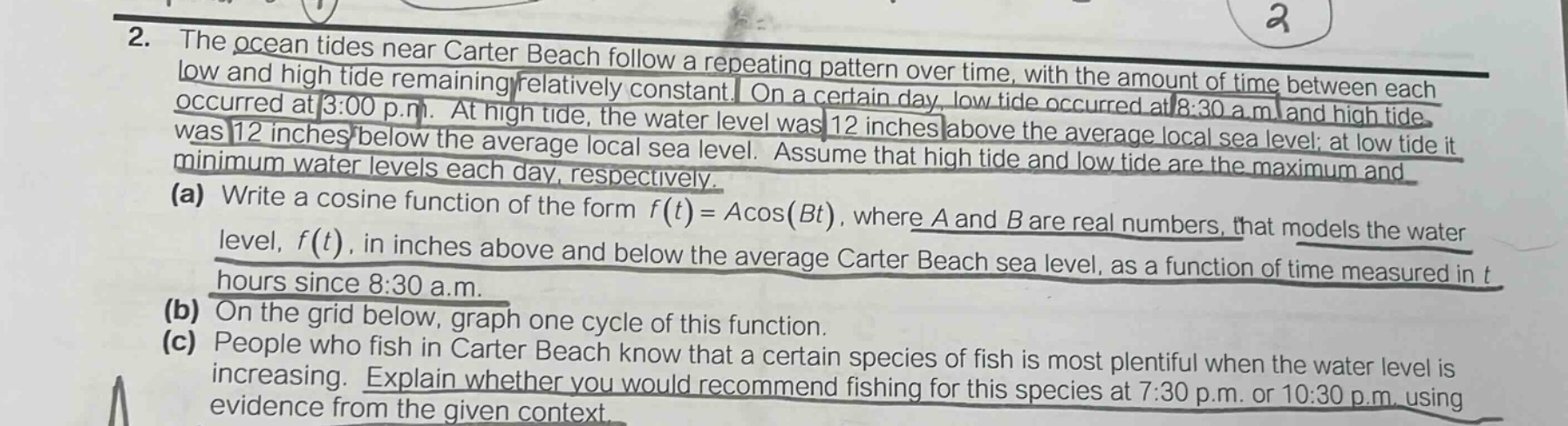
2. the ocean tides near carter beach follow a repeating pattern over time, with the amount of time between each low and high tide remaining relatively constant. on a certain day, low tide occurred at 8:30 a.m. and high tide occurred at 3:00 p.m. at high tide, the water level was 12 inches above the average local sea level; at low tide it was 12 inches below the average local sea level. assume that high tide and low tide are the maximum and minimum water levels each day, respectively. (a) write a cosine function of the form f(t)=acos(bt), where a and b are real numbers, that models the water level, f(t), in inches above and below the average carter beach sea level, as a function of time measured in t hours since 8:30 a.m. (b) on the grid below, graph one cycle of this function. (c) people who fish in carter beach know that a certain species of fish is most plentiful when the water level is increasing. explain whether you would recommend fishing for this species at 7:30 p.m. or 10:30 p.m. using evidence from the given context.
Answer
Explanation:
Step1: Find the amplitude A
The amplitude is half the difference between the high - and low - tide levels. The high - tide is 12 inches above the average and the low - tide is 12 inches below the average. So, $A = 12$.
Step2: Find the period T and the value of B
The time between low - tide (8:30 a.m.) and high - tide (3:00 p.m.) is 6.5 hours. The period of a cosine function for tides is the time between two consecutive low - tides or two consecutive high - tides, so $T=13$ hours. The formula for the period of $y = A\cos(Bt)$ is $T=\frac{2\pi}{B}$. Solving for $B$ with $T = 13$, we get $B=\frac{2\pi}{13}$.
Step3: Write the cosine function
The cosine function is $f(t)=12\cos(\frac{2\pi}{13}t)$.
Step4: Analyze the derivative for fishing times
The derivative of $y = f(t)=12\cos(\frac{2\pi}{13}t)$ is $y^\prime=- \frac{24\pi}{13}\sin(\frac{2\pi}{13}t)$. At 7:30 p.m., $t = 11$ (since 7:30 p.m. is 11 hours after 8:30 a.m.). Then $y^\prime=- \frac{24\pi}{13}\sin(\frac{2\pi\times11}{13})$. Since $\sin(\frac{22\pi}{13})<0$, $y^\prime>0$, so the water level is increasing. At 10:30 p.m., $t = 14$ (since 10:30 p.m. is 14 hours after 8:30 a.m.). Then $y^\prime=- \frac{24\pi}{13}\sin(\frac{2\pi\times14}{13})$. Since $\sin(\frac{28\pi}{13})>0$, $y^\prime<0$, so the water level is decreasing.
Answer:
(a) $f(t)=12\cos(\frac{2\pi}{13}t)$ (b) To graph $y = 12\cos(\frac{2\pi}{13}t)$, the amplitude is 12, the period is 13. The key points for one - cycle of $y=\cos(x)$ are $(0,1),(\frac{\pi}{2},0),(\pi, - 1),(\frac{3\pi}{2},0),(2\pi,1)$. For $y = 12\cos(\frac{2\pi}{13}t)$, when $t = 0,y = 12$; when $t=\frac{13}{4},y = 0$; when $t=\frac{13}{2},y=-12$; when $t=\frac{39}{4},y = 0$; when $t = 13,y = 12$. (c) Recommend fishing at 7:30 p.m. because the water level is increasing at that time, while it is decreasing at 10:30 p.m.