if $f(x)$ is an odd function and the graph of $f(x)$ includes points in quadrant iv, which statement about…
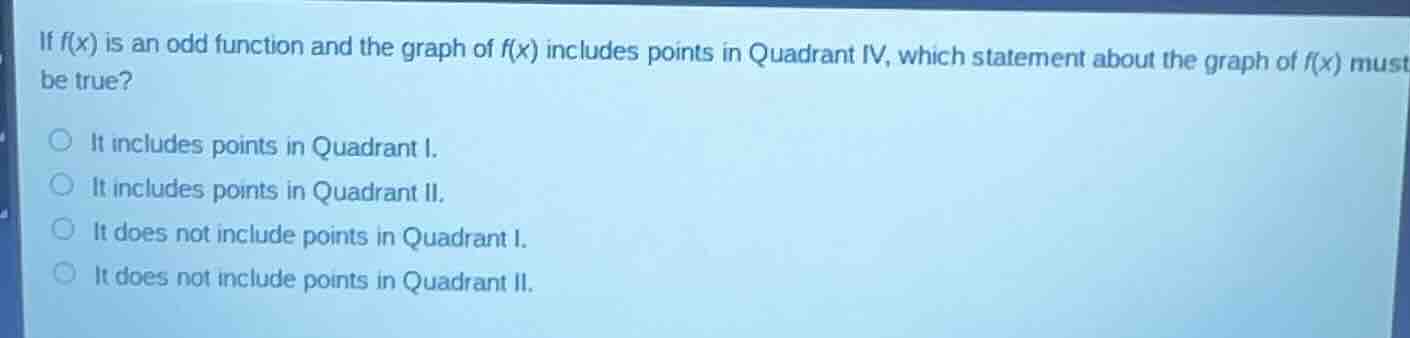
if $f(x)$ is an odd function and the graph of $f(x)$ includes points in quadrant iv, which statement about the graph of $f(x)$ must be true?\nit includes points in quadrant i.\nit includes points in quadrant ii.\nit does not include points in quadrant i.\nit does not include points in quadrant ii.
Answer
Explanation:
Step1: Recall odd function property
For an odd function, $f(-x) = -f(x)$. This means if $(a, b)$ is on the graph, then $(-a, -b)$ is also on the graph.
Step2: Analyze Quadrant IV point
A point in Quadrant IV has positive $x$ and negative $y$, e.g., $(a, -b)$ where $a>0, b>0$.
Step3: Find corresponding symmetric point
Using the odd function property, the symmetric point is $(-a, b)$. This point has negative $x$ and positive $y$, which is in Quadrant II.
Step4: Evaluate all options
Since we proved a Quadrant II point must exist, we check the options:
- Option 1: Not necessarily true (e.g., $f(x)=-x^3$ has Quadrant IV points but no Quadrant I points)
- Option 2: Must be true from Step 3
- Option 3: False (some odd functions can have Quadrant I points, e.g., $f(x)=x$)
- Option 4: False (we proved Quadrant II points exist)
Answer:
It includes points in Quadrant II.