if $f(x)$ is an odd function, which statement about the graph of $f(x)$ must be true?\nit has rotational…
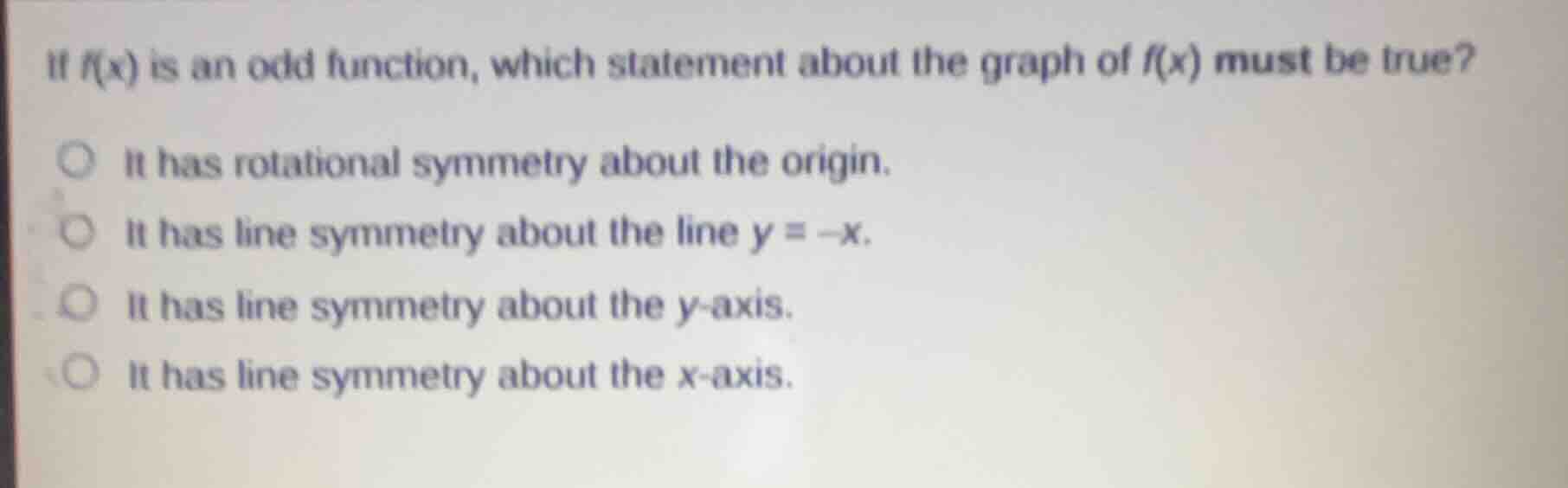
if $f(x)$ is an odd function, which statement about the graph of $f(x)$ must be true?\nit has rotational symmetry about the origin.\nit has line symmetry about the line $y = -x$.\nit has line symmetry about the $y$-axis.\nit has line symmetry about the $x$-axis.
Answer
Brief Explanations:
An odd function satisfies the definition $f(-x) = -f(x)$ for all $x$ in its domain. This means that for every point $(x, y)$ on the graph, the point $(-x, -y)$ is also on the graph, which is the definition of rotational symmetry about the origin. Line symmetry about $y=-x$, the y-axis, or x-axis does not apply to all odd functions: y-axis symmetry is for even functions, x-axis symmetry is not a property of functions (as it would fail the vertical line test), and $y=-x$ symmetry is not a universal property of odd functions.
Answer:
It has rotational symmetry about the origin.