7. one city c, is 30 miles north and 35 miles east from another city, d. at noon, a car starts north from c…
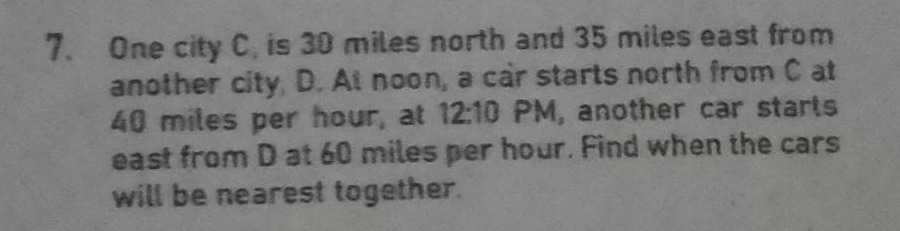
7. one city c, is 30 miles north and 35 miles east from another city, d. at noon, a car starts north from c at 40 miles per hour, at 12:10 pm, another car starts east from d at 60 miles per hour. find when the cars will be nearest together.
Answer
Explanation:
Step1: Set up distance - time variables
Let $t$ be the number of hours that the first car (from city C) has been traveling. Then the second car (from city D) has been traveling $t-\frac{1}{6}$ hours (since it starts 10 minutes or $\frac{10}{60}=\frac{1}{6}$ hours later). The position of the first car moving north from C: Its distance from the starting - point in the north - south direction is $y = 30 + 40t$. The position of the second car moving east from D: Its distance from the starting - point in the east - west direction is $x = 35+60(t - \frac{1}{6})=35 + 60t-10=25 + 60t$.
Step2: Use the distance formula
The distance $s$ between the two cars is given by the Pythagorean theorem $s=\sqrt{x^{2}+y^{2}}$. Substitute $x = 25 + 60t$ and $y = 30 + 40t$ into the formula: [ \begin{align*} s&=\sqrt{(25 + 60t)^{2}+(30 + 40t)^{2}}\ &=\sqrt{625+3000t + 3600t^{2}+900+2400t + 1600t^{2}}\ &=\sqrt{5200t^{2}+5400t + 1525} \end{align*} ] To find the minimum of $s$, we can find the minimum of $s^{2}$ (since minimizing $s^{2}$ is equivalent to minimizing $s$). Let $S=s^{2}=5200t^{2}+5400t + 1525$.
Step3: Take the derivative
Differentiate $S$ with respect to $t$: $S^\prime=10400t + 5400$.
Step4: Set the derivative equal to zero
Set $S^\prime = 0$ to find the critical points: [ \begin{align*} 10400t+5400&=0\ 10400t&=- 5400\ t&=-\frac{5400}{10400}=-\frac{27}{52} \end{align*} ] This is incorrect. Let's start over with the correct distance formula. Let $t$ be the number of hours the car from C has been traveling. The car from D has been traveling $t-\frac{1}{6}$ hours. The distance $d$ between the two cars is given by: [ \begin{align*} d^{2}&=(35 - 60(t-\frac{1}{6}))^{2}+(30 - 40t)^{2}\ &=(35-60t + 10)^{2}+(30 - 40t)^{2}\ &=(45-60t)^{2}+(30 - 40t)^{2}\ &=2025-5400t + 3600t^{2}+900-2400t + 1600t^{2}\ &=5200t^{2}-7800t + 2925 \end{align*} ] Differentiate $d^{2}$ with respect to $t$: $(d^{2})^\prime = 10400t-7800$. Set $(d^{2})^\prime=0$: [ \begin{align*} 10400t-7800&=0\ 10400t&=7800\ t&=\frac{7800}{10400}=\frac{3}{4}\text{ hours} \end{align*} ] Since $\frac{3}{4}$ hours $ = 45$ minutes. The cars will be nearest together 45 minutes after the first car starts, so at 12:45 PM.
Answer:
12:45 PM