one cycle of the graph of a trigonometric function of the form y = a sin (bx) or y = a cos (bx) is given…
one cycle of the graph of a trigonometric function of the form y = a sin (bx) or y = a cos (bx) is given. determine the equation of the function represented by the following graph. the graph represents a function of the form for b > 0. a cos (bx) a sin (bx)
Answer
Explanation:
Step1: Check the y - intercept
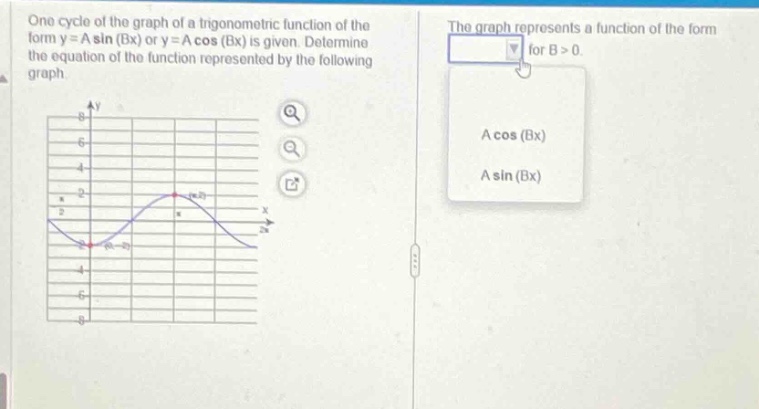
The graph passes through the point ((0, - 2)). For (y = A\sin(Bx)), when (x = 0), (y=A\sin(0)=0). For (y = A\cos(Bx)), when (x = 0), (y = A\cos(0)=A). Since the (y) - intercept is non - zero ((y=-2) when (x = 0)), the function is of the form (y = A\cos(Bx)).
Step2: Determine the amplitude (A)
The amplitude (A) is the maximum distance from the mid - line of the graph to its peak or trough. The mid - line of the graph is (y = 0), and the maximum value of the function is (2) and the minimum is (-2). So, (|A| = 2). Since the graph starts at (y=-2) (when (x = 0)), (A=-2).
Step3: Determine the period and (B)
The period (T) of a cosine function (y = A\cos(Bx)) is given by (T=\frac{2\pi}{B}). From the graph, the period (T = 8). So, (8=\frac{2\pi}{B}), then (B=\frac{\pi}{4}).
Answer:
(y=-2\cos(\frac{\pi}{4}x))