which one of the following statements is true? a. the mean value theorem for derivatives applies to…
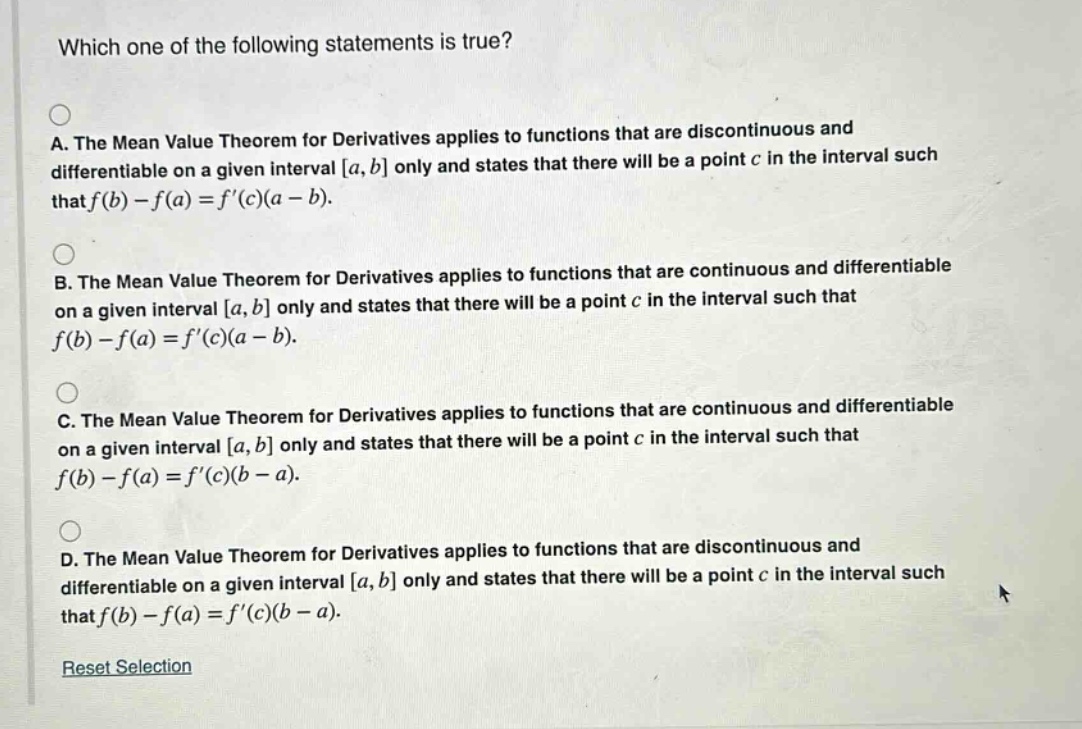
which one of the following statements is true? a. the mean value theorem for derivatives applies to functions that are discontinuous and differentiable on a given interval a, b only and states that there will be a point c in the interval such that f(b) - f(a) = f(c)(a - b). b. the mean value theorem for derivatives applies to functions that are continuous and differentiable on a given interval a, b only and states that there will be a point c in the interval such that f(b) - f(a) = f(c)(a - b). c. the mean value theorem for derivatives applies to functions that are continuous and differentiable on a given interval a, b only and states that there will be a point c in the interval such that f(b) - f(a) = f(c)(b - a). d. the mean value theorem for derivatives applies to functions that are discontinuous and differentiable on a given interval a, b only and states that there will be a point c in the interval such that f(b) - f(a) = f(c)(b - a). reset selection
Answer
Brief Explanations:
The Mean - Value Theorem for Derivatives applies to functions that are continuous and differentiable on a closed interval $[a,b]$. Its formula is $f(b)-f(a)=f^{\prime}(c)(b - a)$, where $c\in(a,b)$. Options A and D are wrong because the function must be continuous. Option B has the wrong formula for the theorem.
Answer:
C. The Mean Value Theorem for Derivatives applies to functions that are continuous and differentiable on a given interval $[a,b]$ only and states that there will be a point $c$ in the interval such that $f(b)-f(a)=f^{\prime}(c)(b - a)$.