9. at one time, maple leaf village (which no longer exists) had north americas largest ferris wheel. the…
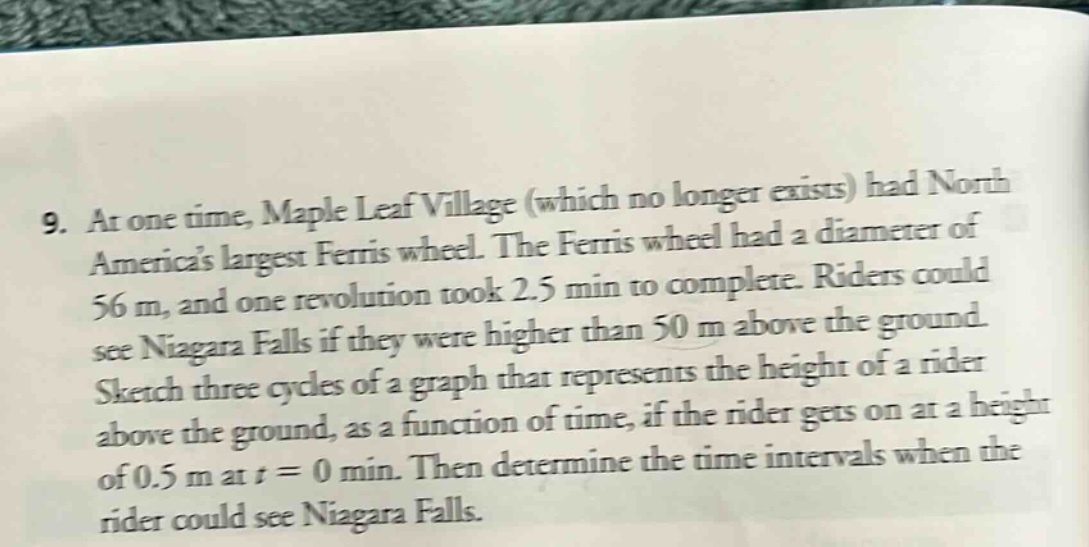
9. at one time, maple leaf village (which no longer exists) had north americas largest ferris wheel. the ferris wheel had a diameter of 56 m, and one revolution took 2.5 min to complete. riders could see niagara falls if they were higher than 50 m above the ground. sketch three cycles of a graph that represents the height of a rider above the ground, as a function of time, if the rider gets on at a height of 0.5 m at t = 0 min. then determine the time intervals when the rider could see niagara falls.
Answer
Explanation:
Step1: Determine the radius and center - height
The diameter of the Ferris - wheel is $d = 56$ m, so the radius $r=28$ m. The center of the Ferris - wheel is at a height of $h = 28 + 0.5=28.5$ m above the ground.
Step2: Write the general form of the sinusoidal function
The general form of a sinusoidal function for height $y$ as a function of time $t$ is $y = A\sin(B(t - C))+D$. Here, $A$ is the amplitude, $B$ is related to the period, $C$ is the phase - shift, and $D$ is the vertical shift. The amplitude $A = 28$ (radius of the Ferris - wheel), the period $T = 2.5$ min. Since $B=\frac{2\pi}{T}$, then $B=\frac{2\pi}{2.5}=\frac{4\pi}{5}$. The rider starts at $y = 0.5$ m at $t = 0$, so the phase - shift $C = 0$ and the vertical shift $D = 28.5$. The function is $y=28\sin(\frac{4\pi}{5}t)+28.5$.
Step3: Find the time intervals when $y>50$
Set $y>50$, so $28\sin(\frac{4\pi}{5}t)+28.5>50$. First, isolate the sine function: $28\sin(\frac{4\pi}{5}t)>50 - 28.5=21.5$. Then $\sin(\frac{4\pi}{5}t)>\frac{21.5}{28}\approx0.7679$. We know that $\sin^{-1}(0.7679)\approx0.879$ and $\pi-\sin^{-1}(0.7679)\approx2.263$. So, $\frac{4\pi}{5}t\in(0.879 + 2k\pi,2.263+2k\pi)$ for $k = 0,1,2,\cdots$. Solve for $t$: $t\in(\frac{0.879\times5}{4\pi}+ \frac{2k\pi\times5}{4\pi},\frac{2.263\times5}{4\pi}+\frac{2k\pi\times5}{4\pi})$. For $k = 0$: $t\in(\frac{0.879\times5}{4\pi},\frac{2.263\times5}{4\pi})\approx(\frac{4.395}{4\pi},\frac{11.315}{4\pi})\approx(0.35,0.90)$. Since the period $T = 2.5$ min, for $k = 1$: $t\in(\frac{4.395}{4\pi}+2.5,\frac{11.315}{4\pi}+2.5)\approx(0.35 + 2.5,0.90+2.5)=(2.85,3.40)$. For $k = 2$: $t\in(\frac{4.395}{4\pi}+5,\frac{11.315}{4\pi}+5)\approx(0.35 + 5,0.90+5)=(5.35,5.90)$.
To sketch the graph:
- The amplitude is 28, the vertical shift is 28.5, and the period is 2.5 min. The function starts at $(0,0.5)$. We can plot key points such as the maximum ($y = 28 + 28.5=56.5$), minimum ($y=-28 + 28.5 = 0.5$), and mid - line $y = 28.5$ for each period.
Answer:
The time intervals when the rider could see Niagara Falls are approximately $(0.35,0.90)$ min, $(2.85,3.40)$ min, $(5.35,5.90)$ min for the first three cycles.