what are the open intervals of decrease for the given rational function below? f(x)=-1/(x^2 - 36) o (-∞,∞) o…
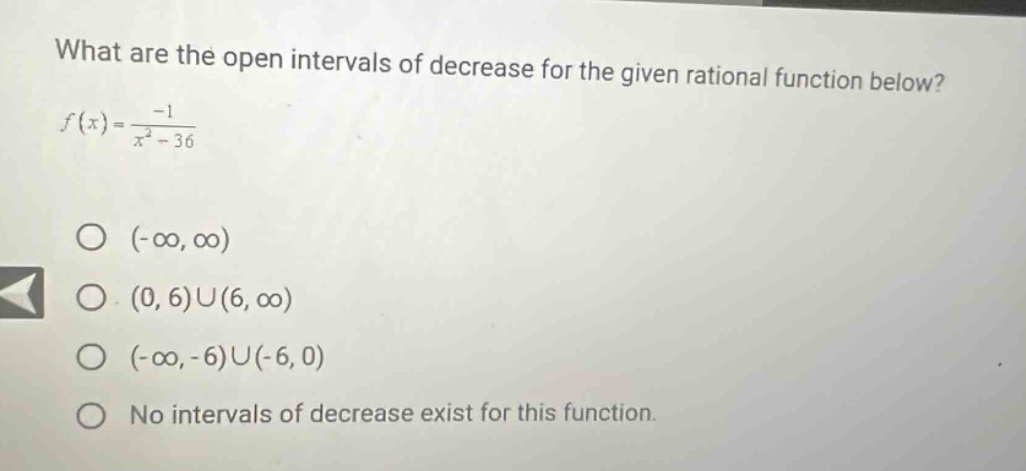
what are the open intervals of decrease for the given rational function below? f(x)=-1/(x^2 - 36) o (-∞,∞) o (0,6)∪(6,∞) o (-∞,-6)∪(-6,0) o no intervals of decrease exist for this function.
Answer
Explanation:
Step1: Find the derivative of the function
We use the quotient - rule. If $f(x)=\frac{u}{v}$ where $u = - 1$ and $v=x^{2}-36$, then $u'=0$ and $v' = 2x$. The quotient - rule states that $f'(x)=\frac{u'v - uv'}{v^{2}}$. So $f'(x)=\frac{0\times(x^{2}-36)-(-1)\times2x}{(x^{2}-36)^{2}}=\frac{2x}{(x^{2}-36)^{2}}$.
Step2: Find the critical points
Set $f'(x) = 0$. Since $f'(x)=\frac{2x}{(x^{2}-36)^{2}}$, and $(x^{2}-36)^{2}\gt0$ for all $x\neq\pm6$, we set the numerator equal to 0. So $2x = 0$, which gives $x = 0$. The function is undefined at $x=\pm6$ (because the denominator $x^{2}-36=(x + 6)(x - 6)=0$ at $x=\pm6$).
Step3: Test the intervals
We consider the intervals $(-\infty,-6)$, $(-6,0)$, $(0,6)$ and $(6,\infty)$.
- For $x\in(-\infty,-6)$, let $x=-7$. Then $f'(-7)=\frac{2\times(-7)}{((-7)^{2}-36)^{2}}=\frac{-14}{(49 - 36)^{2}}=\frac{-14}{169}\lt0$.
- For $x\in(-6,0)$, let $x=-1$. Then $f'(-1)=\frac{2\times(-1)}{((-1)^{2}-36)^{2}}=\frac{-2}{(1 - 36)^{2}}=\frac{-2}{1225}\lt0$.
- For $x\in(0,6)$, let $x = 1$. Then $f'(1)=\frac{2\times1}{(1^{2}-36)^{2}}=\frac{2}{1225}\gt0$.
- For $x\in(6,\infty)$, let $x = 7$. Then $f'(7)=\frac{2\times7}{(7^{2}-36)^{2}}=\frac{14}{169}\gt0$.
The function is decreasing on the intervals $(-\infty,-6)\cup(-6,0)$.
Answer:
$(-\infty,-6)\cup(-6,0)$