what are the open intervals of decrease for the given rational function below? f(x)=1/(x² - 5x + 6) (2.5…
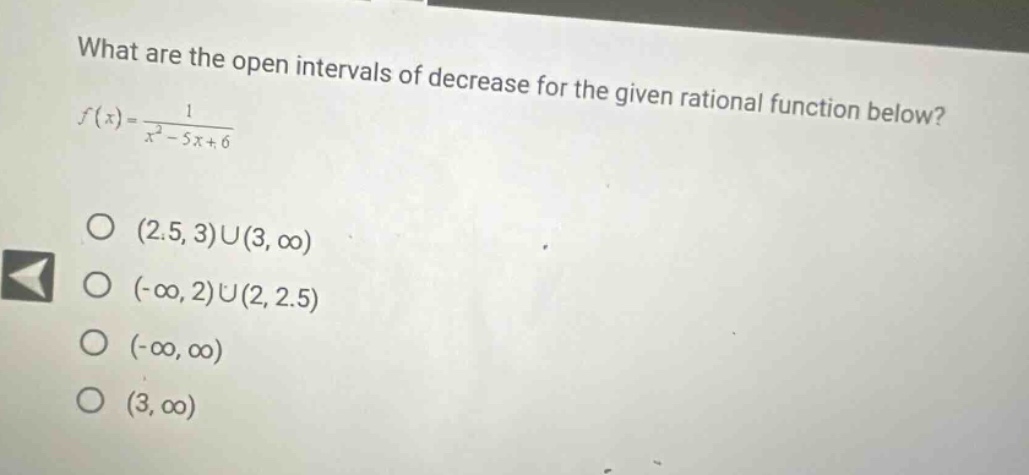
what are the open intervals of decrease for the given rational function below? f(x)=1/(x² - 5x + 6) (2.5, 3)u(3, ∞) (-∞, 2)u(2, 2.5) (-∞, ∞) (3, ∞)
Answer
Explanation:
Step1: Rewrite the denominator
First, factor the denominator $x^{2}-5x + 6=(x - 2)(x - 3)$. So $f(x)=\frac{1}{(x - 2)(x - 3)}=\frac{1}{x^{2}-5x + 6}$.
Step2: Find the derivative
Use the quotient - rule. If $y=\frac{u}{v}$, then $y^\prime=\frac{u^\prime v - uv^\prime}{v^{2}}$. Here, $u = 1$, $u^\prime=0$, $v=x^{2}-5x + 6$, $v^\prime=2x - 5$. So $f^\prime(x)=\frac{0\times(x^{2}-5x + 6)-1\times(2x - 5)}{(x^{2}-5x + 6)^{2}}=-\frac{2x - 5}{(x - 2)^{2}(x - 3)^{2}}$.
Step3: Find where the derivative is negative
The function $f(x)$ is decreasing when $f^\prime(x)<0$. Since $(x - 2)^{2}(x - 3)^{2}>0$ for all $x\neq2$ and $x\neq3$, we need to solve $-(2x - 5)<0$, which is equivalent to $2x-5>0$, so $x > 2.5$. Also, we need to exclude $x = 2$ and $x = 3$ (because the function is not defined at these points). So the open intervals of decrease are $(2.5,3)\cup(3,\infty)$.
Answer:
$(2.5,3)\cup(3,\infty)$