optimization\nquestion 2, 4.5.31\nhw score: 30%, 3 of 10 points\npoints: 0 of 2\na 6 - ft - tall fence runs…
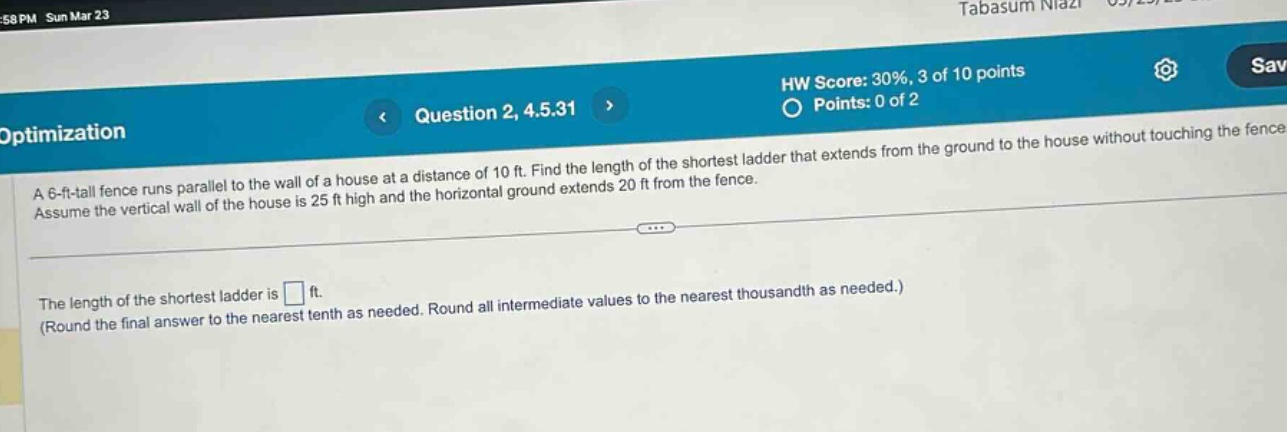
optimization\nquestion 2, 4.5.31\nhw score: 30%, 3 of 10 points\npoints: 0 of 2\na 6 - ft - tall fence runs parallel to the wall of a house at a distance of 10 ft. find the length of the shortest ladder that extends from the ground to the house without touching the fence. assume the vertical wall of the house is 25 ft high and the horizontal ground extends 20 ft from the fence.\nthe length of the shortest ladder is □ ft.\n(round the final answer to the nearest tenth as needed. round all intermediate values to the nearest thousandth as needed.)
Answer
Explanation:
Step1: Set up similar - triangles relationship
Let $x$ be the distance from the base of the fence to the base of the ladder on the ground. Let $L$ be the length of the ladder. Using similar triangles, if the height of the fence is $h = 6$ ft and the distance from the fence to the house is $d=10$ ft. The height of the point where the ladder touches the house above the ground is $y$ and the base - to - base distance of the ladder is $x + 10$. From similar triangles, $\frac{y}{x + 10}=\frac{6}{x}$, so $y=\frac{6(x + 10)}{x}=6+\frac{60}{x}$.
Step2: Use the Pythagorean theorem
By the Pythagorean theorem, $L^{2}=(x + 10)^{2}+y^{2}$. Substitute $y = 6+\frac{60}{x}$ into the equation: $L^{2}=(x + 10)^{2}+(6+\frac{60}{x})^{2}=x^{2}+20x + 100+36+\frac{720}{x}+\frac{3600}{x^{2}}$. Let $u = L^{2}$, then $u(x)=x^{2}+20x + 136+\frac{720}{x}+\frac{3600}{x^{2}}$.
Step3: Find the derivative
Differentiate $u(x)$ with respect to $x$: $u^\prime(x)=2x + 20-\frac{720}{x^{2}}-\frac{7200}{x^{3}}$. Set $u^\prime(x)=0$ to find the critical points. Multiply through by $x^{3}$ to get $2x^{4}+20x^{3}-720x - 7200 = 0$. Divide by 2: $x^{4}+10x^{3}-360x - 3600 = 0$. We can try to find a root of the equation. By inspection or using a numerical method (e.g., Newton - Raphson method), we find that $x\approx6.708$.
Step4: Calculate the length of the ladder
Substitute $x\approx6.708$ back into the formula for $L$. First, find $y = 6+\frac{60}{6.708}\approx6 + 8.945=14.945$. Then $L=\sqrt{(6.708 + 10)^{2}+14.945^{2}}=\sqrt{16.708^{2}+14.945^{2}}=\sqrt{279.17+223.35}=\sqrt{502.52}\approx22.4$.
Answer:
$22.4$