outside temperature over a day can be modeled as a sinusoidal function. suppose you know the high…
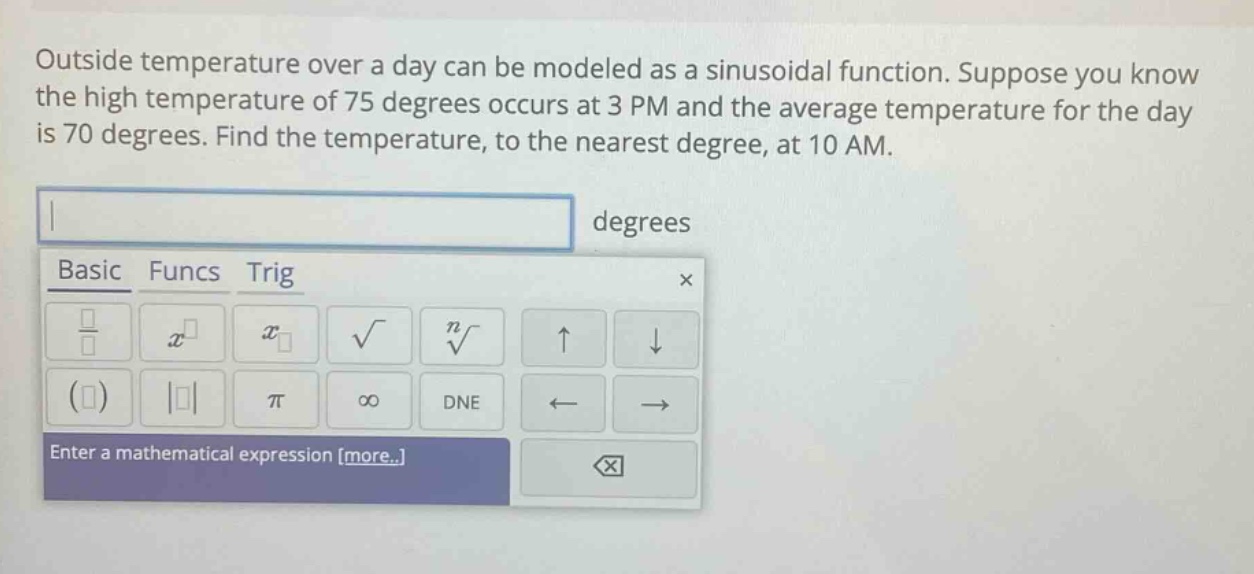
outside temperature over a day can be modeled as a sinusoidal function. suppose you know the high temperature of 75 degrees occurs at 3 pm and the average temperature for the day is 70 degrees. find the temperature, to the nearest degree, at 10 am. degrees basic funcs trig enter a mathematical expression more..
Answer
Explanation:
Step1: Determine the amplitude
The amplitude $A$ of the sinusoidal - function is the difference between the high - temperature and the average temperature. Given the high temperature $T_{max}=75$ degrees and the average temperature $T_{avg}=70$ degrees. So, $A = 75 - 70=5$.
Step2: Determine the period
The period $P$ of the temperature function is 24 hours (since it's a daily cycle), so $P = 24$. The angular frequency $\omega=\frac{2\pi}{P}=\frac{2\pi}{24}=\frac{\pi}{12}$.
Step3: Set up the sinusoidal function
We can use the form $T(t)=A\sin(\omega(t - t_0))+T_{avg}$, where $t$ is the time, $t_0$ is the time when the maximum occurs. The maximum occurs at $t = 3$ PM. Let $t = 0$ be midnight. So $t_0 = 15$ (since 3 PM is 15 hours after midnight). Then $T(t)=5\sin(\frac{\pi}{12}(t - 15))+70$.
Step4: Calculate the temperature at 10 AM
10 AM is $t = 10$ hours after midnight. Substitute $t = 10$ into the function: [ \begin{align*} T(10)&=5\sin(\frac{\pi}{12}(10 - 15))+70\ &=5\sin(-\frac{5\pi}{12})+70 \end{align*} ] We know that $\sin(-\alpha)=-\sin(\alpha)$, and $\sin(\frac{5\pi}{12})=\sin(\frac{\pi}{4}+\frac{\pi}{6})=\sin\frac{\pi}{4}\cos\frac{\pi}{6}+\cos\frac{\pi}{4}\sin\frac{\pi}{6}=\frac{\sqrt{2}}{2}\times\frac{\sqrt{3}}{2}+\frac{\sqrt{2}}{2}\times\frac{1}{2}=\frac{\sqrt{6}+\sqrt{2}}{4}\approx0.966$. So $T(10)=70-5\times0.966 = 70 - 4.83\approx65$.
Answer:
65