outside temperature over a day can be modeled as a sinusoidal function. suppose you know the temperature…
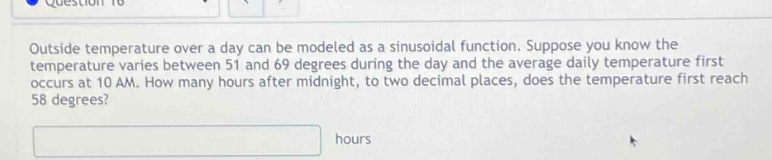
outside temperature over a day can be modeled as a sinusoidal function. suppose you know the temperature varies between 51 and 69 degrees during the day and the average daily temperature first occurs at 10 am. how many hours after midnight, to two decimal places, does the temperature first reach 58 degrees? hours
Answer
Explanation:
Step1: Determine the sinusoidal - function parameters
The general form of a sinusoidal function is $y = A\sin(B(x - C))+D$. The amplitude $A=\frac{69 - 51}{2}=9$, the vertical shift $D=\frac{69 + 51}{2}=60$. The period of a daily - temperature function is $T = 24$ hours, and since $T=\frac{2\pi}{B}$, then $B=\frac{2\pi}{24}=\frac{\pi}{12}$. The average temperature $y = 60$ first occurs at $x = 10$ (10 AM), so the phase - shift $C = 10$. Thus, the temperature function is $y=9\sin\left(\frac{\pi}{12}(x - 10)\right)+60$.
Step2: Set up the equation to solve for $x$
We want to find $x$ when $y = 58$. So we set up the equation $58=9\sin\left(\frac{\pi}{12}(x - 10)\right)+60$. First, subtract 60 from both sides: $58−60 = 9\sin\left(\frac{\pi}{12}(x - 10)\right)$, which gives $- 2=9\sin\left(\frac{\pi}{12}(x - 10)\right)$. Then $\sin\left(\frac{\pi}{12}(x - 10)\right)=-\frac{2}{9}$.
Step3: Solve for $x$
We know that if $\sin\theta=-\frac{2}{9}$, then $\theta=\sin^{-1}\left(-\frac{2}{9}\right)+2k\pi$ or $\theta=\pi-\sin^{-1}\left(-\frac{2}{9}\right)+2k\pi,k\in\mathbb{Z}$. We want the first non - negative solution for $x$. Let $\theta=\frac{\pi}{12}(x - 10)$. $\frac{\pi}{12}(x - 10)=\sin^{-1}\left(-\frac{2}{9}\right)$. $x - 10=\frac{12}{\pi}\sin^{-1}\left(-\frac{2}{9}\right)$. $\sin^{-1}\left(-\frac{2}{9}\right)\approx - 0.224$. $x - 10=\frac{12}{\pi}\times(-0.224)\approx - 0.85$. $x=10 - 0.85 = 9.15$.
Answer:
$9.15$