outside temperature over a day can be modelled as a sinusoidal function. suppose you know the high…
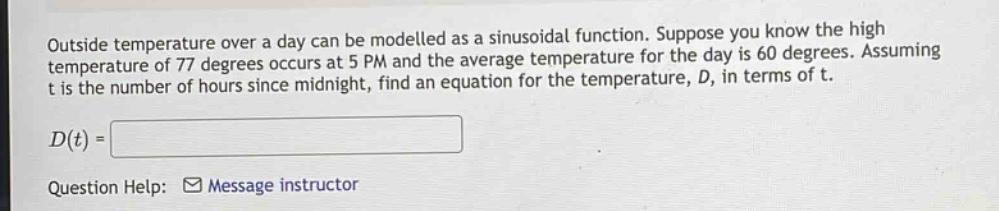
outside temperature over a day can be modelled as a sinusoidal function. suppose you know the high temperature of 77 degrees occurs at 5 pm and the average temperature for the day is 60 degrees. assuming t is the number of hours since midnight, find an equation for the temperature, d, in terms of t. d(t) = question help: message instructor
Answer
Explanation:
Step1: Determine the amplitude
The amplitude $A$ is the difference between the high - temperature and the average temperature. $A=77 - 60=17$.
Step2: Determine the vertical shift
The vertical shift $k$ is the average temperature. So $k = 60$.
Step3: Determine the period
The period of a daily temperature function is $T = 24$ hours. The formula for the angular frequency $\omega=\frac{2\pi}{T}$, so $\omega=\frac{2\pi}{24}=\frac{\pi}{12}$.
Step4: Determine the phase shift
The high - temperature occurs at $t = 17$ (since 5 PM is 17 hours after midnight). For a sine function of the form $y = A\sin(\omega(t - h))+k$, when $y$ reaches its maximum, $\sin(\omega(t - h)) = 1$. For $y = A\sin(\omega(t - h))+k$, the maximum of $\sin x$ occurs at $x=\frac{\pi}{2}+2n\pi,n\in\mathbb{Z}$. We set $\omega(17 - h)=\frac{\pi}{2}$. Substituting $\omega=\frac{\pi}{12}$, we have $\frac{\pi}{12}(17 - h)=\frac{\pi}{2}$. Solving for $h$: [ \begin{align*} \frac{\pi}{12}(17 - h)&=\frac{\pi}{2}\ 17 - h&=6\ h&=11 \end{align*} ]
Step5: Write the function
The general form of a sinusoidal function is $D(t)=A\sin(\omega(t - h))+k$. Substituting $A = 17$, $\omega=\frac{\pi}{12}$, $h = 11$, and $k = 60$, we get $D(t)=17\sin\left(\frac{\pi}{12}(t - 11)\right)+60$.
Answer:
$D(t)=17\sin\left(\frac{\pi}{12}(t - 11)\right)+60$