overall accuracy: 100% record: 2 score: 2 if q(x)=d(m(x)), then q(x)= d(m(x))m(x) d(x)m(x)+m(x)d(x) d(m(x))…
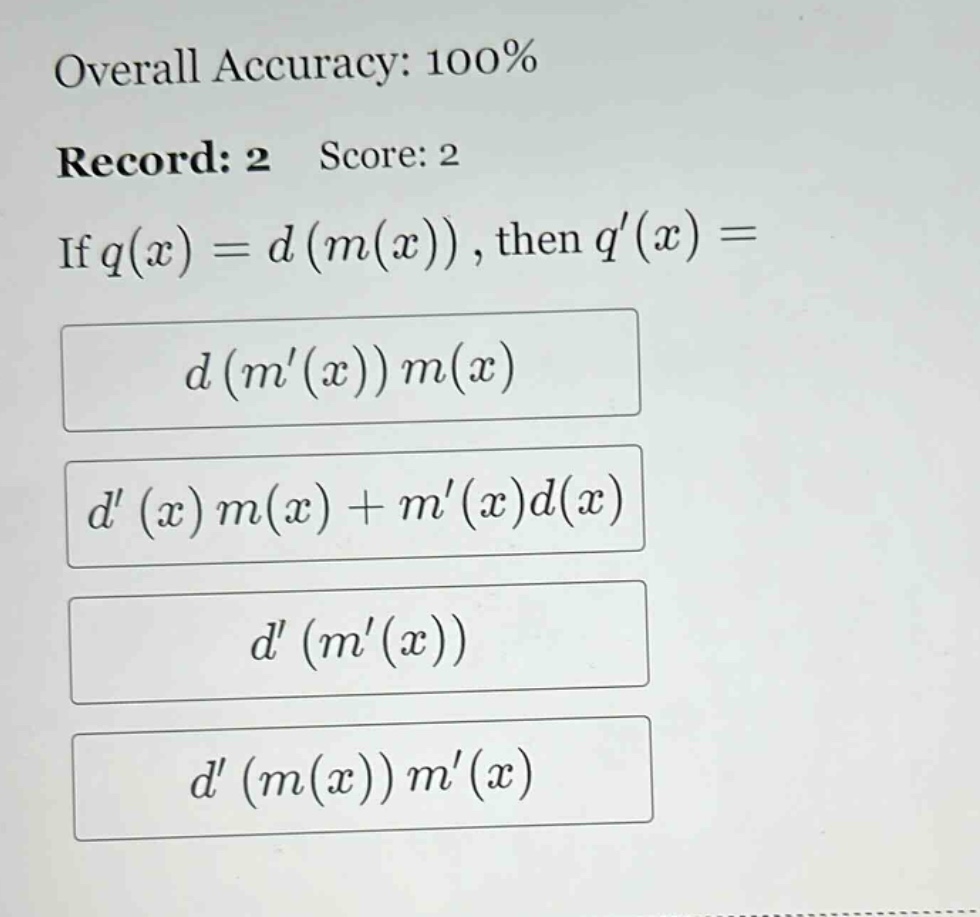
overall accuracy: 100% record: 2 score: 2 if q(x)=d(m(x)), then q(x)= d(m(x))m(x) d(x)m(x)+m(x)d(x) d(m(x)) d(m(x))m(x)
Answer
Explanation:
Step1: Identify the chain - rule
The chain - rule states that if $y = f(g(x))$, then $y'=f'(g(x))\cdot g'(x)$. Here, $q(x)=d(m(x))$, where $f = d$ and $g = m$.
Step2: Apply the chain - rule
By the chain - rule, the derivative of $q(x)$ with respect to $x$ is $q'(x)=d'(m(x))\cdot m'(x)$.
Answer:
$d'(m(x))m'(x)$