overall accuracy: 78.6% record: 8 score: 8 if f(x) = ∫-1,x²cos(2t)dt, then f(x) = sin(2x²) 2x sin(2x²) 2x…
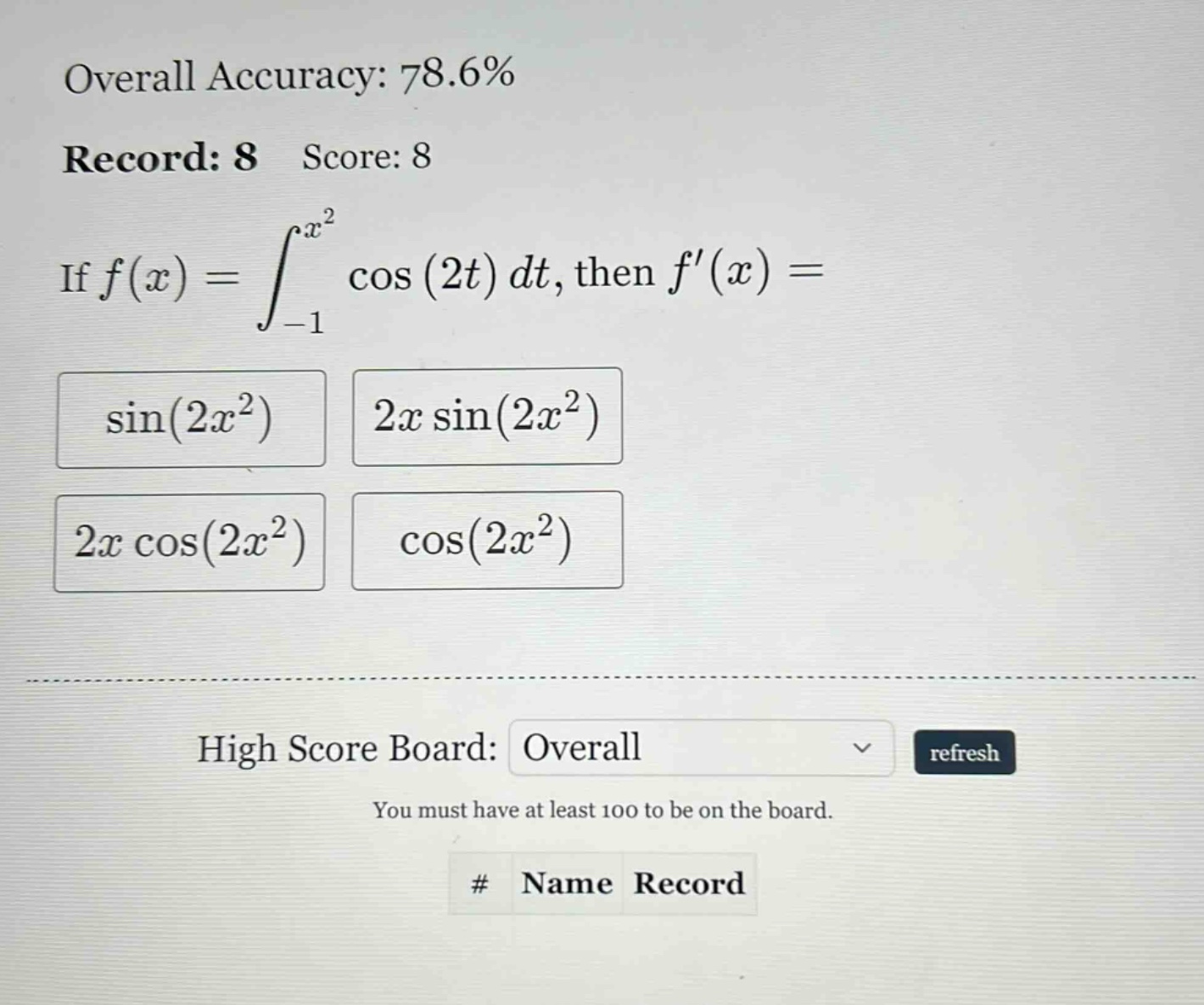
overall accuracy: 78.6% record: 8 score: 8 if f(x) = ∫-1,x²cos(2t)dt, then f(x) = sin(2x²) 2x sin(2x²) 2x cos(2x²) cos(2x²) high score board: overall refresh you must have at least 100 to be on the board. # name record
Answer
Explanation:
Step1: Apply the fundamental theorem of calculus and chain - rule
Let $u = x^{2}$, then $f(x)=\int_{-1}^{u}\cos(2t)dt$. By the fundamental theorem of calculus, if $F(t)$ is an antiderivative of $\cos(2t)$ (i.e., $F^\prime(t)=\cos(2t)$), then $\int_{-1}^{u}\cos(2t)dt=F(u)-F(-1)$. And by the chain - rule, $f^\prime(x)=\frac{d}{dx}(F(u)-F(-1))$. Since $F(-1)$ is a constant, its derivative is 0. So $f^\prime(x)=F^\prime(u)\cdot\frac{du}{dx}$.
Step2: Calculate the derivatives
We know that $F^\prime(u)=\cos(2u)$ (by the fundamental theorem of calculus) and $\frac{du}{dx} = 2x$ (since $u = x^{2}$). Substituting $u = x^{2}$ back into $F^\prime(u)$, we get $F^\prime(u)=\cos(2x^{2})$. Then $f^\prime(x)=\cos(2x^{2})\cdot2x = 2x\cos(2x^{2})$.
Answer:
$2x\cos(2x^{2})$